
The third annual LINA Summit for local and independent news publishers was held in Melbourne, Victoria, in April 2025. We’ve compiled key takeaways and tips for newsrooms from each session, so LINA members who were unable to attend can find resources on topics ranging from audience trust and solutions journalism, to SEO and newsletter strategies.
Session Summaries
- Aligning profit with purpose
- Revenue ideas workshop
- Media kit workshop
- How to build your listings revenue
- Lightning talks
- Our News. Your Voice: Collective fundraising campaign
- Making money from multimedia
- Building brand recognition
- Revenue Growth Program 2025: Show and tell
- Successful business models around the world
Session summaries
Presentation slides available to LINA members only.
Keynote presentation
International News Media Association – Jodie Hopperton
The words news and journalism are often used interechangeably, but they’re not the same. Jodie Hopperton joined us to explore this idea and the role of local news in the information economy.
- Local news plays a significant role in the dissemination of crucial information in a crisis.
- Emergency events prompt increases in community engagement and support for local news post-crisis.
- Local newsrooms need to actively fight misinformation with factually driven narratives.
Aligning profit with purpose
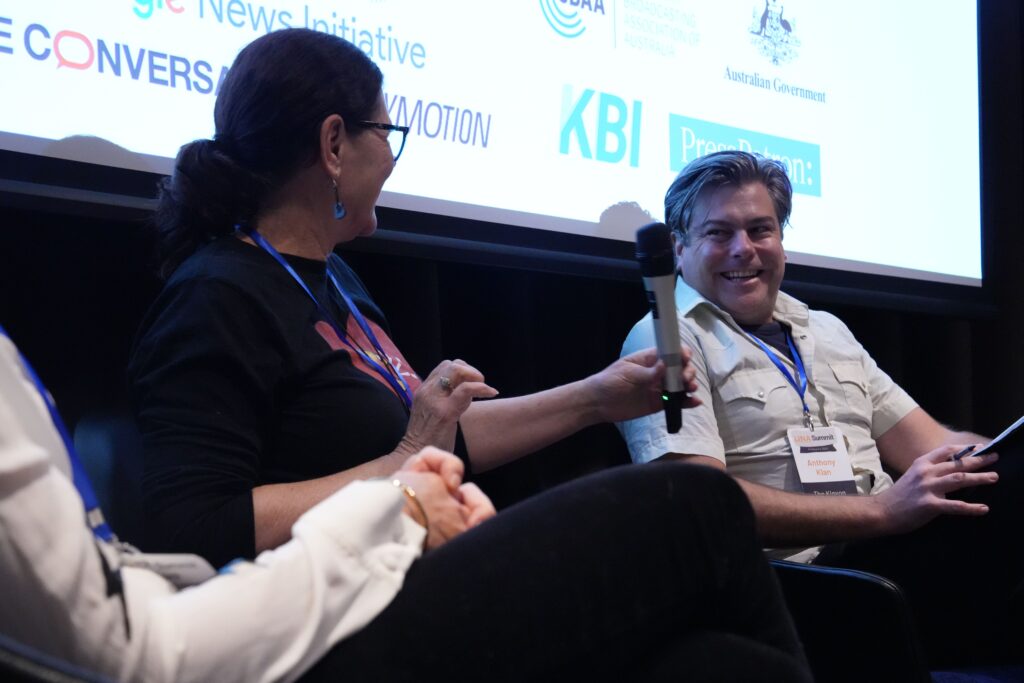
Croakey Health Media – Melissa Sweet, The Klaxon – Anthony Klan, The Conversation – Margy Vary
This panel explored the alignment of profit and purpose in journalism, focusing on defining and measuring impact, systems thinking, and accurate social impact reporting.
- Understanding and intentionally defining ‘impact’ is crucial. Different definitions, such as net positive change and long-term societal change, require careful consideration to avoid overclaiming and maintain credibility with stakeholders.
- The theory of change is vital for mapping inputs, outputs, and outcomes, which helps organizations measure their impact effectively and efficiently. This approach is especially important for engaging funders who seek assurance that their resources are used effectively.
- Systems thinking aids in viewing projects within the larger ecosystem, revealing how different media roles fit into the wider context and showcasing a model’s unique suitability for specific objectives, as demonstrated by The Guardian and The Conversation.
- Develop a clear and intentional definition of ‘impact’ specific to your organisation’s goals, ensuring alignment with globally accepted standards and making it easier to communicate with stakeholders.
- Create a theory of change for current projects to clearly outline the causal links between inputs and desired impacts, assisting in efficient resource allocation and providing a transparent framework for funders.
- Integrate systems thinking into strategic planning by considering how your organisation fits into the broader media ecosystem, allowing for better adaptation to stakeholders’ needs and increasing the appeal of your funding proposals.
From founder to leader
Nurture HR Consulting – Eva Wright
Eva Wright from Nurture HR Consulting shared how to identify and develop leadership styles to suit different situations and a growing team. She also provided a framework for succession planning to ensure the team continues to thrive and evolve.
- Be flexible with your leadership style. Different situations call for different approaches.
- Publishers struggle with being able to balance their time between Leading vs Managing vs Operating.
- Take stock of your team dynamics and what stage of team development they’re at: Forming, Storming, Norming or Performing.
- Identify your default leadership style.
- Think about the good leaders you’ve had in your life and how you can model their behaviour.
- Use LINA’s HR for Newsrooms service to help with succession planning
Reporting with care: mental health
Mindframe – Elizabeth Paton, Star Observer – Chloe Sargeant
Elizabeth Paton shared best-practice advice and tools to support responsible reporting of news related to mental health, suicide and alcohol and drugs, while Chloe Sargeant spoke of the harm of irresponsible reporting on LGBTIQA+ communities.
- The effects of stigma are often more distressing than the symptoms of an illness
- Werther effect: problematic communication about suicide deaths is associated with increased rates of suicide and attempts
- Positive impacts—Papageno effect: sharing stories of people who have got through a suicidal crisis, or sharing ‘alternatives’ to suicide
- Be careful not to out, misgender, misrepresent or erase LGBTIQA+ people and communities.
- If you don’t think you’re the right person to tell a story, say so
- Stories about systemic issues e.g. shortage of psychiatrists, are important, but media should always highlight many different types of supports available. E.g. local headspace, peer support worker, online services, mental health social worker. Don’t promote sense of helplessness.
- Help to demystify e.g. stories about what’s it like to call up Lifeline.
- Contact Mindframe to access free resources or support: mindframe@health.nsw.gov.au, or access additional resources here.
- Make current best-practice guidelines available for your newsrooms’ journalists to access as needed.
- Could hold a team training on LGBTIQA+ reporting e.g. ACON pride training
- Reach out to an LGBTIQA+ organisation to share lived experiences for relevant stories e.g. Star Observer
If you need support, you can contact Support Act a 24/7 Mental Health Counselling service: 1800 959 500.
Building audience relationships
International News Media Association – Jodie Hopperton, Western Weekender – Troy Dodds, Western Echo – Melanie Grevis-James, Murray Bridge News – Peri Strathearn
Do you know what your audience wants? How? Troy Dodds (Western Weekender), Melanie Grevis-James (Western Echo) and Peri Strathearn (Murray Bridge News) shared some innovative ways to understand your audience and strengthen your community connections.
Ethics in reporting
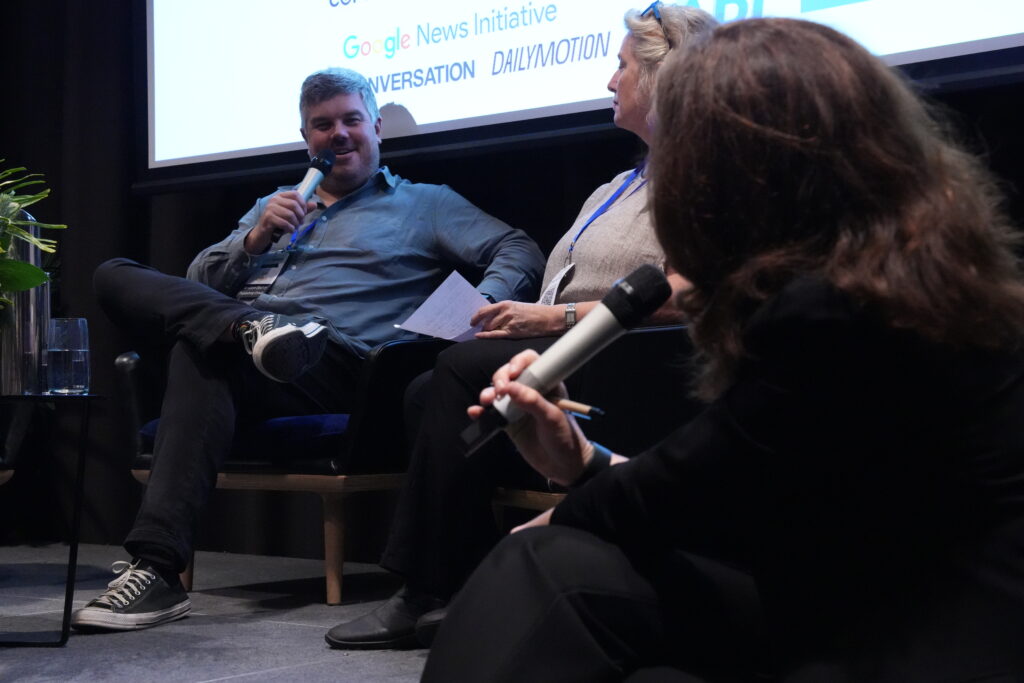
Australian Press Council – Paul Nangle, MEAA / Brunswick Voice – Mark Phillips, Tasmanian Inquirer – Bob Burton, LINA Board Member – Alan Sunderland
Panel discussion focused on ethics in journalism and media accountability. Key topics included the importance of transparency, maintaining editorial standards around advertising, disclosing political donations, and protecting source confidentiality.
- Transparency is key: engage with the ethical processes, show your “workings” about ethical decisions e.g. through editorials
- Maintain strict editorial rules around advertising relationships
- Implement clear disclosure policies for political donations above $1,000
- Use current guidelines for reporting on sensitive topics e.g. domestic violence
- Establish clear protocols for protecting source confidentiality
- Develop transparent correction and complaint procedures for publications
- Publish your code of ethics
- Publish complaints form
- Publish link to Australian Press Council complaints
- Be iterative with journalism (particularly suited to digital journalism). Follow-up mistakes or suggestions for alternative views.
Establishing good workplace culture
Nurture HR – Eva Wright
Eva Wright from Nurture HR Consulting shared her knowledge on how to keep teams engaged, by establishing and maintaining good workplace culture. The session explored how to be mindful of ‘unwritten rules’ that can impact team morale and how to foster a sense of belonging in the workplace.
- The way you present your workplace, impacts the expectations of new employees when they enter it.
- Good workplace culture can be impacted by ‘unwritten rules’ and barriers such as ‘the boys club’.
- A workplace that aligns with its stated values creates genuinely good workplace culture.
- Assess your current workplace culture to ensure it aligns with what you want it to be. You can use the Edgar Shein culture model of artifacts, norms and assumptions.
- Encourage your team to speak openly and honestly about how they feel in the workplace.
- Plot a course of action to maintain, or course correct, the culture of your workplace.
Revenue ideas workshop
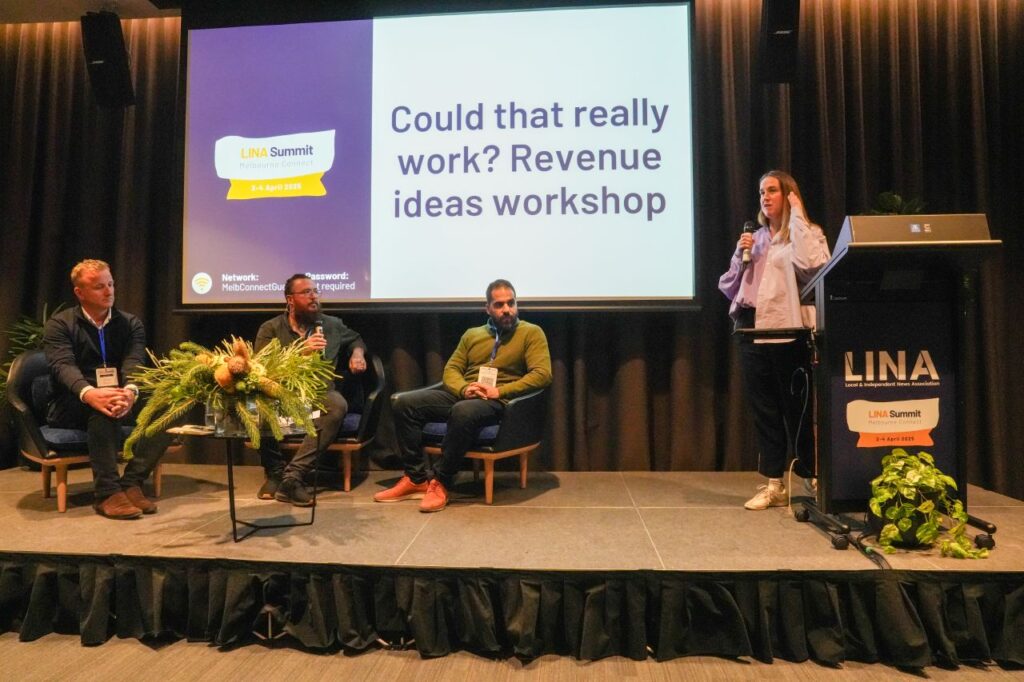
Bastion Agency – Jenni Ryall, State of Digital Publishing – Vahe Arabian, 8CCC – Benjamin Erin, Interplay Media – James Spinks
Panelists shared insights on innovative revenue models. Topics included experimentation, community engagement, brand partnerships, and evolving revenue strategies with a strong emphasis on video, cross-platform opportunities, LinkedIn, and email monetisation.
- Emphasising video content is crucial as a significant revenue stream for digital publishers, with the potential to enhance engagement and monetisation.
- Building strong partnerships and relationships within the industry can aid in diversifying revenue opportunities
- Trying new strategies and learning from failures can lead to innovative and successful revenue models.
- Develop and implement a comprehensive video content strategy to capitalise on its potential for increasing audience engagement and revenue.
- Strengthen industry relationships and explore new partnership opportunities to diversify revenue streams and increase long-term sustainability.
- Conduct a 12-week experimental project focused on a specific revenue initiative, evaluating its outcomes and potential for scaling up.
Keeping it clean: Publishing and the law
ABC – Corey Jankie, Copyright Agency – Josephine Johnston, In The Cove – Jacky Barker
This panel discussion covered best practice for avoiding problems with copyright and defamation and provided general advice on what to do when your own work’s copyright has been infringed.
- The infringement of copyrighted content in digital spaces is continuing.
- Give notice first, when pursuing cases of copyright infringement, by sending an email to the editor of the publication who has used your content.
- Publishers are concerned about the unauthorised use of their content by AI and other media organisations.
What this means for digital publishers:
- Advocate with the government for solutions to licensing AI-trained datasets and other technological disruptions.
- Join Copyright Agency in order to claim royalties for your work.
- Implement collective licenses for organisations to manage the sharing of content
- Watermark your content to make it more difficult for others to use it without crediting you.
Reach your peeps: newsletter strategies
Future Media – Ricky Sutton
In this session, Ricky explained how the platform can help local news publishers make money and share their content and provided some tips on how to write and market a great newsletter.
- The best way to create a newsletter is to just get started; start writing, and publish consistently. Pick a niche topic, and go for it.
- Substack is the ideal platform for running a paid newsletter system. Half of all content on Substack is paid.
- Future Media’s leads come primarily through word of mouth, followed by Substack notes (an in-site feed) and then social media like LinkedIn.
- Allow limited free subscriber content, but charge for the majority of your work.
- To know which articles to charge for, look to pieces that have helped your reader make money, or pieces that have information that took lots of research or are covering topics that can only be found on your platform.
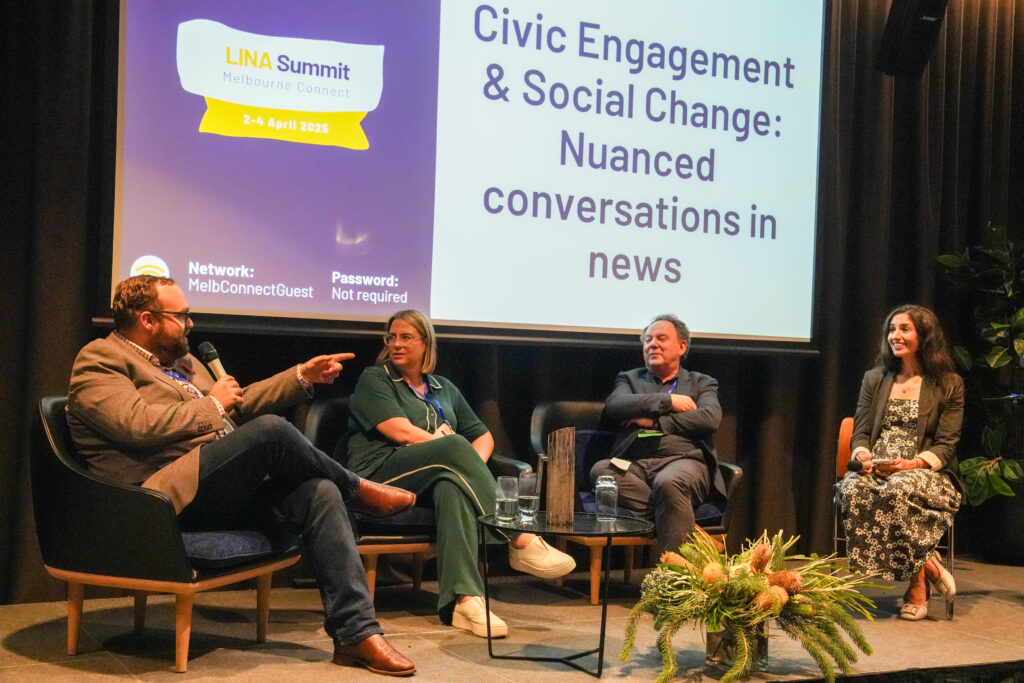
Civic engagement & social change: nuanced conversations in news
James Blackwell – Croakey Health Media, Georgina Harrisson – Amplify, Andrew Jaspan – 360info
This panel covered how news can spark discussions of important topics in our communities with care, nuance and facts.
- Some studies indicate that Australia is experiencing declining levels of civic engagement and participation in social change.
- This is evident in reduced participation in social and community groups, as well as lower levels of interest in political activities and events, according to the Australian Leadership Index. A core feature of this is reduced trust in Australian institutions such as government bodies and media.
- Use 360info for free, high quality republish able explainer content for newsrooms
Media kit workshop
Kenny Katzgrau – Redbank Green/Broadstreet
In this workshop, Kenny walked step-by-step through the media kit he uses at his local news publication Redbank Green in the US. He provided specific tips on how to close a sales deal with digital and print advertising, and which elements of a media kit are the most useful. Then, he invited audience members to show their media kits to him and be reviewed.
- A media kit is not a menu — they’re usually confusing to everyday people. It’s a poor replacement for a sales person, and acts better as a conversation starter.
- Media kits should be made FOR the client. Can they trust you? Do they feel like you can help them? Pricing isn’t the top priority. Keep it simple.
- Sometimes if you send the rates without a conversation, the client might just ghost because they don’t understand the value of the advertising, and you haven’t had the chance to explain it to them.
- Take a look at Kenny’s media kit for Red Bank Green for some inspiration
- More free guides and resources from Red Bank Green
News publishing & Big Tech
Claire Stuchbery – LINA
This session explored the relationship between news publishing and big tech, with a focus on the role of LINA in supporting its members in this evolving landscape. Key topics included the challenges and opportunities presented by AI, the need for collective bargaining and legal representation when dealing with tech giants, and the importance of inclusive policies that support smaller publishers based on editorial standards.
- LINA members want to extend the News Media Bargaining Code to include smaller publishers based on editorial standards, not just income.
- They want LINA to represent them in collective bargaining with tech giants, especially Meta, and to address AI’s challenges and opportunities.
- They also appreciate LINA’s relationship with Google and desire similar engagement with Meta.
How to build your listings revenue
Google – Chris Burgess
Aggy and Jamie of Newsport demonstrated a software tool that Newsport has been developing: NewsREAM. This tool has allowed Newsport to leverage their existing relationships with their local real estate sector to sell local advertisements. In its second year, the tool produced over $50,000 in revenue.
- It is possible to generate revenue via real estate listings even with competition from companies such as The REA Group and Domain
- Create revenue through real estate advertorials and NewsREAM ad listing packages
- Newsport is planning on sharing their NewsREAM tool with the wider LINA community once development is complete
- Improve your publication’s authority in the real estate space by creating consistent property coverage
- Establish your publication as the local real estate expects, but allow a year or two for this to take place
- Build content through relationships with local agents and industry professionals
Improving accessibility: Reach more of your community
Conrad Browne – Vision Australia Radio
Conrad explained who Vision Australia are, and why their role in improving accessibility is so important. He then shared some specific and helpful tips for news publishers to ensure their articles and multimedia content are accessible to those navigating vision loss.
How to make your written content accessible:
- Use plain language
- Use descriptive link text e.g. instead of simply using two words ‘click here’, write something longer like ‘click here to learn more about xyz’
- Break up content with sub headings, shorter paragraphs
- Alt text: provide descriptions under images that can be read to someone with a visual impairment. Keep it at 1-2 sentences
- Color contrast: Make sure text and background colours aren’t too similar
- Use accessible fonts, e.g. simple ones like Arial
- Avoid background images (can be distracting)
How to make video/audio content accessible:
- Provide captions and transcripts
- Audio description
- Clean up audio to make it understandable
Policy forum
Claire Stuchbery – LINA
LINA Executive Director Claire Stuchbery outlined the four main policy priorities that LINA is currently working on, and sought feedback from newsrooms. Claire and Nell (LINA’s Policy Officer) regularly visit Canberra for advocacy, primarily focusing on federal politics due to team capacity constraints.
- LINA policy priorities include: securing legislated government advertising commitments for locally and/or independently produced media, reforms to support not-for-profit newsrooms to access DGR eligibility for donations, updating Local Government Acts to include local digital publications (not just newspapers) and securing funding for newsrooms by expanding grant eligibility guidelines.
- The discussion concluded with concerns about industry perception and the importance of balancing positive growth stories with realistic challenges facing the sector.
- Reach out to Nell to discuss or provide feedback on LINA’s policy priorities
- Keep us up to date with what’s happening in your local or state government, including if there is an issue you would like us to act on.
- Complete the annual LINA survey in July so we can use aggregated data from this (e.g. collective reach/audience size of LINA newsrooms) to advocate on your behalf.
Combatting burnout
Amrita Sidhu – Medianet, Dr Caroline James-Garrod – University of Melbourne, Eva Wright – Nurture HR Consulting, Genevieve Swart – Illawarra Flame
Amrita Sidhu opened this panel discussion with findings highlighting the issue of burnout among Australian journalists, and Dr Caroline James-Garrod followed this with takeaways from her research into technologies impact on this. The panel shared techniques for managing time poverty and mental health challenges due to stress.
- Medianet’s media landscape report shows 72% of journalists experienced burnout in 2023, highlighting a significant industry crisis.
- Technology, particularly smartphones, is contributing to time poverty and poor mental health outcomes, as journalists find it increasingly difficult to disconnect.
- Where possible, set boundaries for yourself and your team, to make room to recharge. Even if it means you take just a 5 minute break from the pressure of the newsroom.
- If possible, invest in employee assistance programs and encourage a culture where good mental health is prioritised.
- Connect with your peers, either within the workplace, or with groups like LINA to find solidarity with those having similar experiences.
If you need support, you can contact Support Act, a 24/7 Mental Health Counselling service: 1800 959 500.
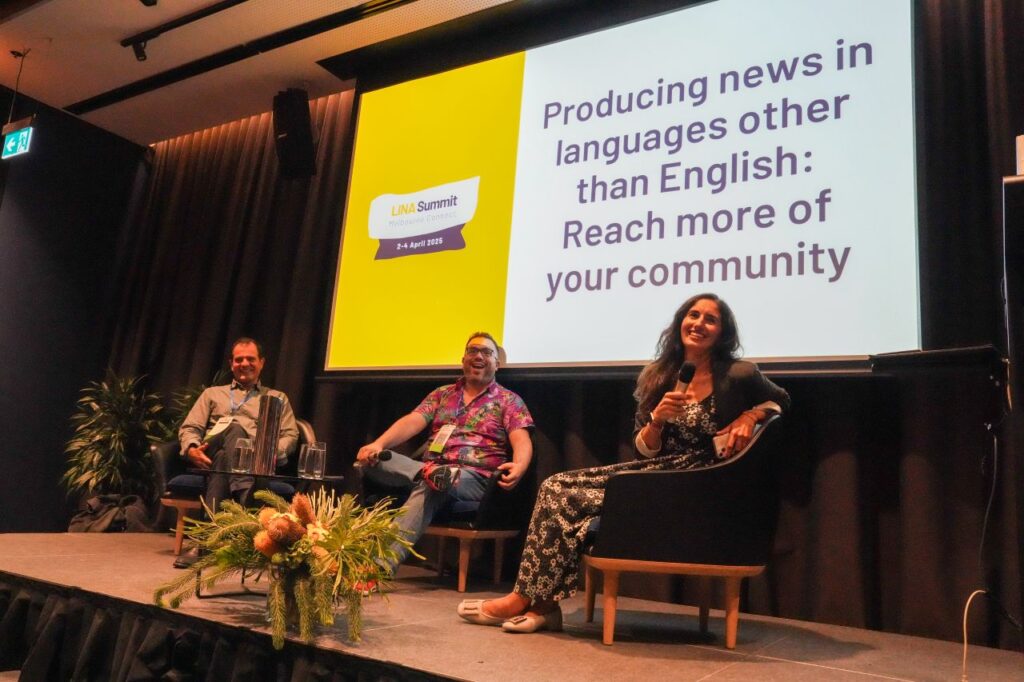
Producing news in languages other than English
Esra Dogramaci – Canva, Christopher Gogos – Neos Kosmos, Eduardo Jordan – Radio 4EB
Australia has a rich linguistic landscape, with around 400 languages spoken across the country, including many Indigenous languages. While English is the official language, the 2021 census showed that 23% of Australians speak a language other than English at home. In many instances, journalists relay not knowing how to report on people from minority groups for fear of misrepresentation or stereotyping.
- When covering minority groups it can be challenging to cover contextual aspects of their culture, which requires time to investigate and learn.
- Avoid the temptation to return to the same “spokesperson” each time you are reporting on that community
- Review the Australian Human Rights Commissions Race Reporting Handbook
Lightning talks
10 news publishers
Ten news publishers shared an elevator pitch on inspiring ideas and learnings in this quick-fire show-and-tell session.
Bob Burton – Tasmanian Inquirer
Tasmanian Inquirer provided examples of a number of stories that have been broken and/or enhanced through freedom of information requests and offered to demonstrate how to access them to interested publishers.
Simon Holt – My City Media
A team is developing a data-scraping widget to easily access business contact information for specific streets, currently in beta testing. The tool aims to reduce manual research time to around 10 minutes.
Kenny Katzgrau – RedBank Green
RedBank Green demonstrated “Party Line,” a WordPress plugin allowing readers to submit content via text message. The system enables coverage of community events, breaking news, and user-generated content while maintaining editorial control.
Suzannah Lyons – 360info
360info presented their research news features wire service, which provides free, in-depth analysis and explainers from academics under Creative Commons licensing. They focus on providing context rather than breaking news or opinion pieces.
Aggy Renaundin – Newsport
Newsport showcased their beach cameras in Port Douglas and Bangkok, attracting 5,000 weekly viewers and providing weather updates and tide information. The cameras are positioned at surf lifesaving clubs.
Liam Fitzgerald – Fitzmedia
Fitzmedia Live presented their local online television platform serving the Warrnambool region, featuring news, sports, and events. The service reaches over 115,000 viewers and generates revenue through corporate video production and advertising.
Susie Williams – Fleurieu App
The Fleurieu App demonstrated effective use of QR codes for increasing downloads and engagement, with codes placed strategically throughout the community and at events.
Melanie Grevis-James – Western Echo
Western Echo shared their First Nations storytelling project, funded by a LINA micro-grant, featuring four stories from local elder Morris about indigenous history and culture in their area.
Belinda Cusack – Unmade
Unmade discussed their podcast strategy, emphasizing the importance of audio quality and professional equipment. The podcast has led to increased media opportunities and audience engagement.
Kaye Rodden – Prom Coast News
Prom Coast News detailed their launch of a community newspaper following the closure of a 139-year-old local paper. Starting with $25,000 in donations, they now produce a fortnightly broadsheet and digital edition serving the Wilson’s Promontory region.
ACMA policy update
Sam Holthouse – ACMA
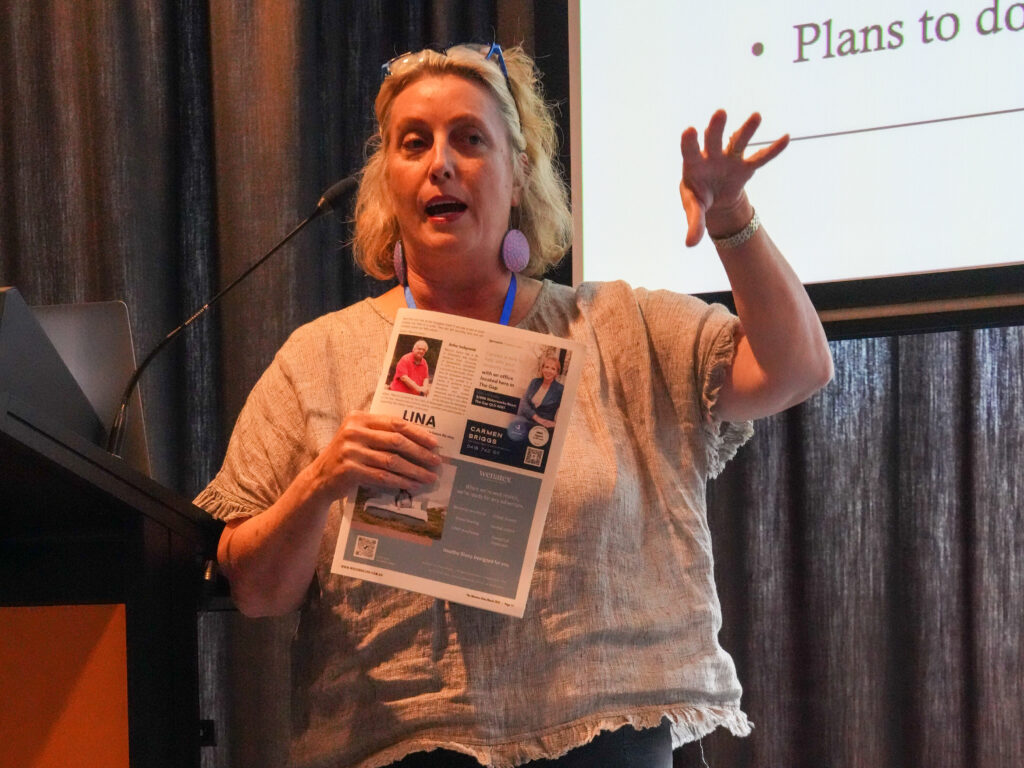
Manager of Media and News Diversity at ACMA Sam Holthouse presented an update on the Media Diversity Measurement Framework. The framework, developed over several years with stakeholder input, consists of six indicators across three domains measuring news media diversity in Australia. The first three indicators relate to source diversity, the fourth indicator focuses on content diversity and indicators five and six look at exposure to diversity.
- About 70% of news brands are part of networks
- Journalism workforce decreased by 19% between 2011-2021
- News websites comprise 40% of professional news outlets, followed by radio at 30%
- Higher levels of public interest journalism were found in regional/remote areas compared to metropolitan areas
- News consumption is declining, particularly among 18-34 age group
- Social media usage for news varies by age: Facebook preferred by those 45+ and Instagram by younger users
- Overall trust in news is declining while distrust is increasing
The report identified significant data gaps and ACMA plans to expand data collection through additional research and stakeholder collaboration. The organisation welcomes feedback on the 2025 report and framework implementation.
Grow your audience on Search
Lais dos Santos – Google
This session focused on improving visibility and effectiveness of news content on Google platforms, involving participants linked to the Google Initiative and local news partners. The session aimed at educating attendees on Google’s policies, optimisation techniques, and tools available for enhancing news presence.
- Emphasis on content freshness and originality, avoiding excessive ad placement on content pages.
- Google’s major ranking factors: relevance, location, prominence, freshness, usability, and interest.
- Use direct feedback and real-world testing.
- Adopt Google’s EEAT (Experience, Expertise, Authoritativeness, Trustworthiness) principles for content creation.
- Implement technical strategies like structured data markups and canonical tags.
- Utilise tools such as Google Search Console and Google Trends for data analysis and content strategy development.
Growing media literacy: How newsrooms can help combat mis and disinformation
Ben James – Australian Associated Press (AAP)
The discussion highlighted the importance of media literacy and fact-checking. It emphasised using a three-question approach to evaluate information sources and the role of pre-bunking in addressing misinformation. The conversation also touches on challenges posed by AI, foreign misinformation sources, and the value of hyperlocal fact-checking.
- Three question approach: consider who’s saying it, why they are saying it (motivations) and the evidence presented.
- Primary sources are critical for verifying factual information, especially in the context of increasing misinformation and AI-generated content.
- Pre-bunking, or addressing potential misinformation before it spreads, can be more effective than traditional debunking methods.
- Engaging with influencers and using platforms like TikTok is essential to reach younger, potentially less media-literate audiences.
- Develop a structured plan to enhance pre-bunking strategies and identify potential misinformation themes.
- Expand collaborations with trusted experts and institutions to strengthen the credibility and reach of fact-checking.
- Implement targeted media literacy programs, particularly in schools, to equip the next generation with critical evaluation skills.
Our News, Your Voice: Collective fundraising campaign
Tammy Schlitz – Balanced Effect
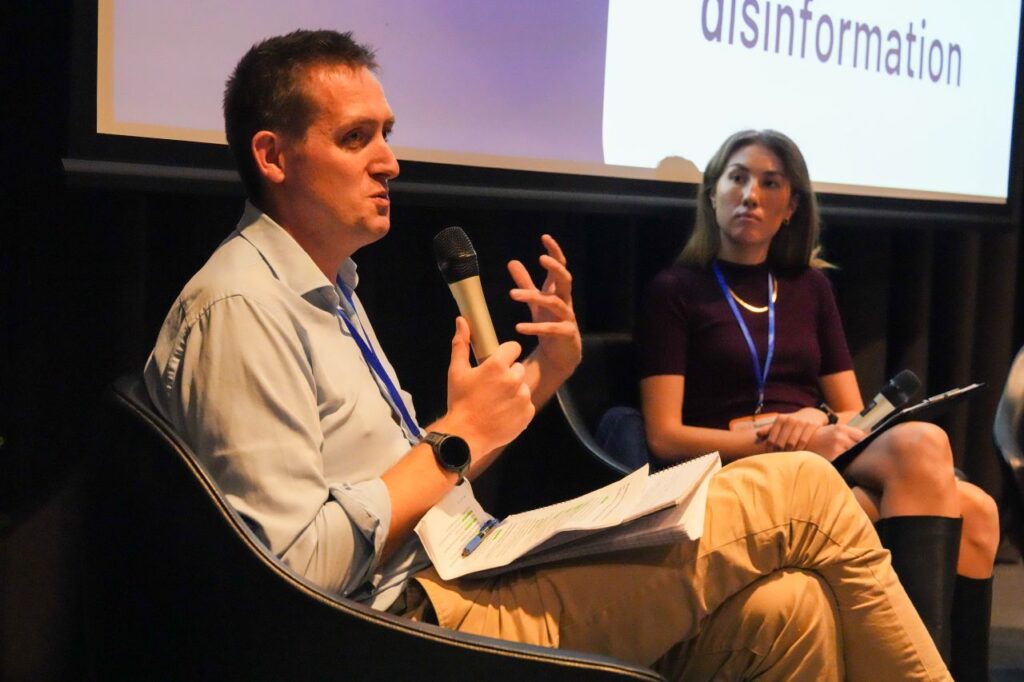
Tammy Schlitz (Balanced Effect) talks newsrooms taking part in the 2025 Our News, Your Voice fundraising campaign through preparation and execution three weeks out for this year’s giving week.
AI policies and processes
Matt Brown – ABC, Josephine Johnston – Copyright Agency, Shaun Davies – Bastion Agency
An outline of copyright implications and content protection involved in the AI data chain and practical applications for AI tools in newsrooms.
- It is important to establish clear principles for AI usage, including consultation with content creators.
- Maintaining transparency with audiences is essential for trust.
- While legal remedies for overseas usage are limited, organisations can protect content through arrangements and tools like Tollbit and Scalepost that track content scraping.
- Review and document acceptable error rates for AI content generation
- Implement data security protocols for AI tool usage and data handling
- Create clear guidelines for image manipulation and generative AI usage
- Develop transparency and disclosure policies for AI-generated content
- Establish consultation process with content creators about AI usage
- Set up quality assurance workflow for AI-generated content review
- Research and evaluate content authenticity tools like C2PA
- Document principles for responsible AI usage in content creation
- Implement process for audience feedback on AI-generated content
Earning and keeping trust
Matt Martino – ABC, Silvia Montaña-Niño – Centre for Advancing Journalism, Bob Burton – Tasmanian Inquirer
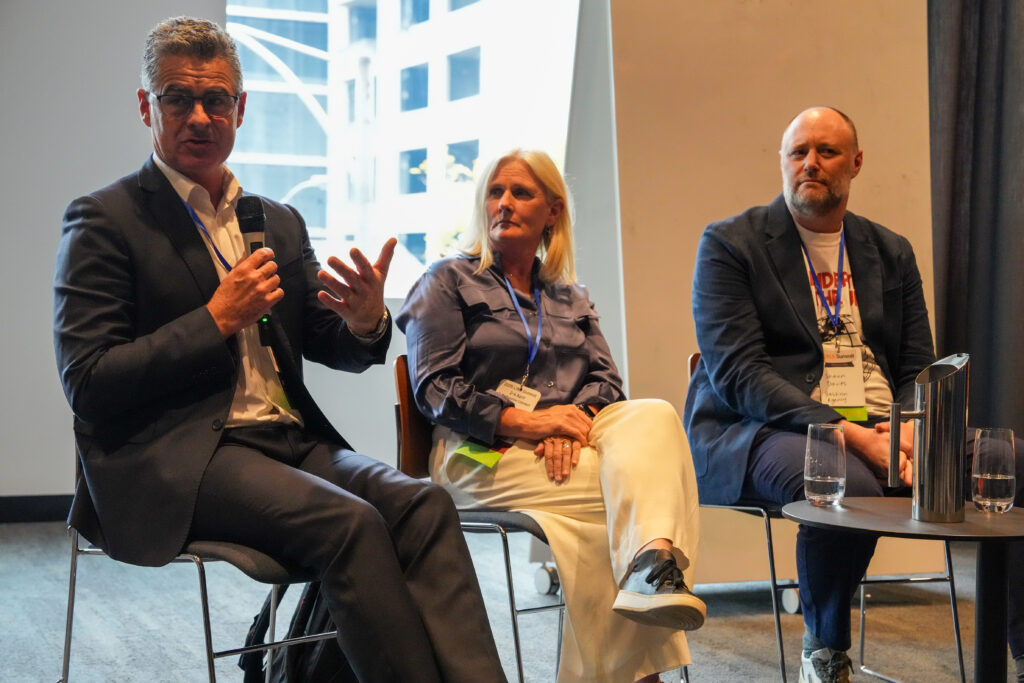
This presentation covers earning and keeping trust in journalism, including the importance of fact-checking and Freedom of Information (FOI) requests. The speakers (ABC Verify Lead Matt Martino, Centre for Advancing Journalism Lecturer Silvia Montaña-Niño and Tasmanian Inquirer Publisher Bob Burton) discussed the changing landscape of fact-checking, the value of FOI requests and provided practical guidance on how to conduct both.
- Bob introduced Tasmania Inquirer, a small newsroom with a high-impact approach, which had won numerous awards through careful use of right to information (FOI) requests to differentiate their journalism. He emphasised the benefits and steps of FOI, noting the importance of having local expertise and understanding legislation nuances.
- Sylvia Montano-Nino discussed the evolving landscape of fact-checking, highlighting changes brought by social media platforms and global conflicts. Fact-checking had shifted from political verification to also addressing misinformation on social media, complicating sustainability for fact-checking organisations. She identified key values in fact-checking practices such as verifiability, detectability, harmfulness, and explainability, proposing a focus on “check-worthiness” over traditional newsworthiness.
- Matt Martino detailed his work at ABC News Verify, focusing on visual verification of user-generated content. He introduced a methodology acronym “SIDE” for verifying content: Stop, Investigate, Discover, and Examine. Martino stressed the importance of verifying location, time, and source, and highlighted tools and practices for building trust and transparency in reporting, such as documenting errors and ensuring verification in articles. The presenters invited questions and offered resources for fact-checking and FOI requests.
- Evaluate your previous FOI requests and consider improvements
- Set a target to complete at least one FOI request this year
- Explore resources from the International Fact-Checking Network and Poynter Institute for fact-checking
- Connect with a local FOI buddy for guidance on legislation

Making money from multimedia
Angela Priestly – Women’s Agenda, Jonas Jaanimagi – IAB Australia, Vanessa Robb – Mercato
Mercato CEO Vanessa Robb took publishers through digital retail media, IAB Tech Lead Jonas Jaanimagi outlined new trends and predictions in digital advertising, and Women’s Agenda Co-Founder Angela Priestly described the partnerships that have made podcasts a successful revenue source for the publication.
- Digital signage: Publishers can sell inventory (on behalf of advertising clients) on the screens and display news real-time and an change the content remotely depending on time, weather etc. Can also be used to showcase news stories and direct traffic to websites.
- Digital advertising: Third party cookies are on their way out, there will soon be a requirement for an explicit notice of consent for advertising (consumers will need to opt in to receive advertising, not out), ‘search’ represents 44% of the total Australian internet advertising market in 2024, video outperforms the broader display advertising market in 2024.
- Podcasts: easier than other revenue strategies e.g. events, a powerful medium (intimate), getting a lot of attention right now e.g. political campaigns and accessible to audiences (e.g. can consume this content while multi-tasking).
- Contact Mercato or LINA for more info about implementing digital signage advertising.
- Try AI tools for podcast creation e.g. transcribing interviews, doing a paper edit.
- Don’t rely on creating content through AI, because advertising models are getting better with identifying and won’t align themselves with this risky content
- Partner with relevant organisations to monetise podcasts.
Big tech and AI update
Jodie Hopperton – International News Media Association (INMA)
This session explored changing consumer behaviour in news consumption, detailed the impact of AI and new technologies on news delivery and covered audio content trends and opportunities.
- Traditional search behaviour is shifting from keyword queries to conversational AI interactions
- AI overview features are appearing at the top of search results, potentially reducing traffic to publisher sites
- Traffic from chatbots is increasing but not fully offsetting decreased search traffic
- Publishers are seeing less data feedback as interactions move to local devices
- There is a growing importance of audio content across age groups
- Voice interfaces are becoming more prevalent through smart speakers and AI assistants
- Tools like Eleven Labs and Notebook LM enabling easy audio content creation
- Publishers need to adapt content for audio consumption rather than simply narrating written articles.
- Monitor AI bot scraping using tools like Tollbit and Scalepost
- Ensure content optimisation strategies need to balance traditional SEO with AI discovery
- Analyse your current content formats and develop strategy for multi-format content delivery (audio, video, text)
- Evaluate your current traffic sources and develop strategy for core audience engagement
- Focus on customer-centric approaches and quality content
- Monitor data carefully to understand changing consumption patterns
- Consider long-term strategy beyond immediate revenue
- Adapt to “liquid content” where traditional format boundaries blur
- Maintain brand strength while exploring new distribution methods
Building brand recognition
Jenn Donovan – Small Business Made Simple podcast
Marketing expert and host of ‘Small Business Made Simple’ podcast Jen Donovan shared her knowledge of how to tell the unique stories behind newsrooms, as well as tools and tips to build brand awareness.
- Your story is unique, so keep telling it. Share the personal stories of your team and news site on a regular basis.
- Consistent branding is key to staying top of mind. Have one image that is instantly recognisable as ‘you’.
- Working with community groups is not only great for your area, but helps you re-enforce your message and builds trust.
- Create a mission statement so you have a clear vision of how you want your community to view you.
- Ensure you have an About Us page.
- Use QR codes for interactive and measurable engagement options.
- Check LINA’s exhaustive list of Tools and Resources that can help you choose palettes and create logos, as well as planning social media posts and more.
- Set up your Impact Tracking dashboard so you can keep track of the feedback you’re getting from your community.
Preparing explainers
Felicity Lewis – The Age, Jean Anselmi – The Westsider, Jordan Hayne – ABC, Suzannah Lyons – 360info
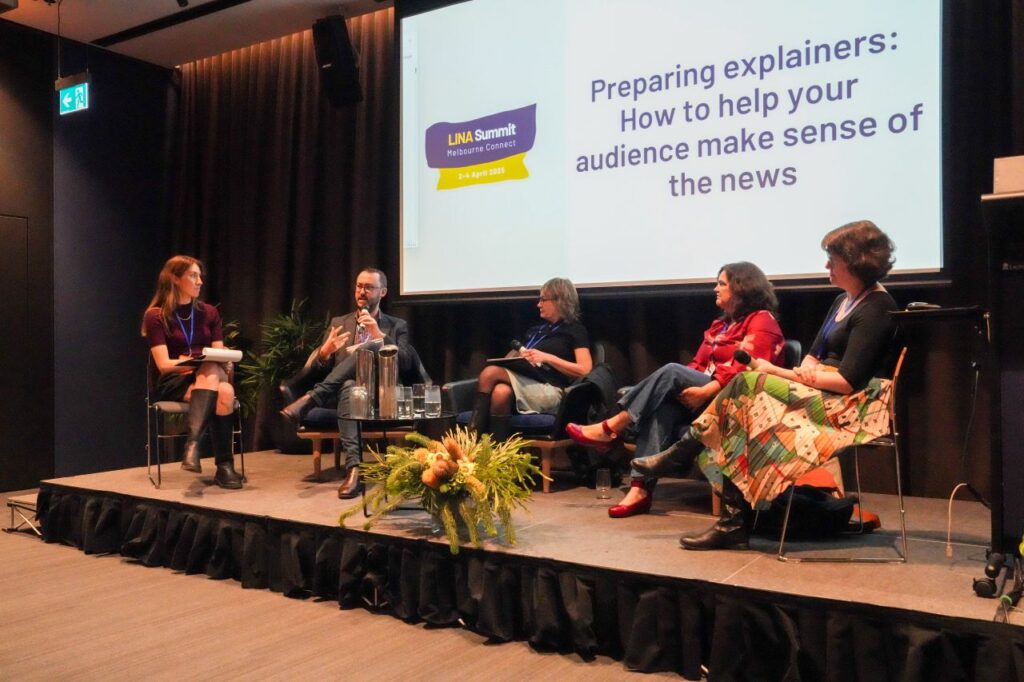
The discussion explored the role and evolution of explainer journalism across various platforms. Panelists emphasised understanding audience needs through data, crafting engaging content with expert input, and presenting complex topics accessibly. The conversation highlighted the importance of visuals and multimedia in storytelling, especially for reaching diverse and younger audiences.
- Explainers are increasingly popular and appreciated by audiences for their ability to provide context and facilitate understanding of complex topics.
- Including expert voices enriches explainer content and enhances its credibility, allowing audiences to grasp nuanced insights.
- Audience engagement and input significantly influence the direction of explainer topics, emphasising the importance of data-driven content creation.
- Develop more explainer content that taps into surprising and niche audience interests, such as geopolitical or scientific topics.
- Enhance the use of multimedia formats, like video and graphics, to present explainers in more engaging and accessible ways.
- Foster collaboration with academic and expert sources to ensure the accuracy and depth of the contextual content provided in explainers.
Reporting on councils
Cat Holloway – Spark Shoalhaven, Josie Vine – The Westsider
This discussion covered council reporting challenges and strategies, relationship building with local government and the importance of transparency in council coverage.
While covering local councils can be challenging, it serves a vital role in community engagement and democratic accountability.Key recommendations included:
- Maintaining professional distance while building working relationships with councilors
- Using multimedia approaches to increase engagement
- Taking advantage of legal resources like ABC’s pro bono defamation service
- Focusing on operational decisions rather than personal conflicts
- Understanding the distinction between council staff and elected officials
- The significant role of CEOs and bureaucrats in council operations, often overshadowing elected officials
- Issues around council transparency and attempts to restrict media access
- The value of multimedia reporting in engaging younger audiences with local government issues
- Use LINA’s pro bono legal service to check council reporting content before publishing
- Sign up for the upcoming defamation workshop on April 15, 2025
- Attend local council meetings to monitor and report on proceedings
- Build relationships with individual councillors as reliable sources while maintaining professional boundaries
- Monitor council spending and budgets, particularly CEO salaries and expenses
- Document and report on planning decisions made by local council
- Create multimedia content (videos, visuals) to better engage younger audiences about council matters
- Register as a Copyright Agency member to protect content being used by councils.
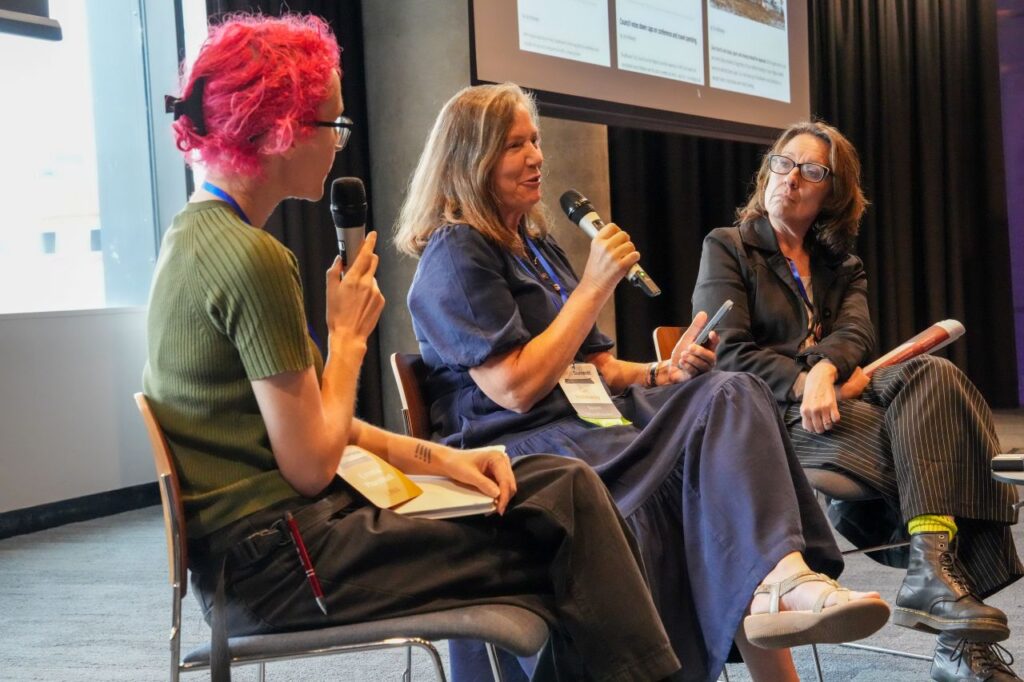
Revenue Growth Program 2025: Show and tell
Jenni Ryall – Bastion Agency, publishers in the 2025 Revenue Growth Program
Publishers shared their projects, experiences and outcomes (so far) of participating in the ongoing Revenue Growth Program, ran by LINA and Bastion Agency.
- It’s important to set a measurable and achievable goal, that may or may not be scalable in the future.
- Mentorship from highly experienced industry experts has been one of the most valuable aspects of the program.
- The program encourages piloting and experimentation, and accountability to some self-imposed deadlines.
- Submit an EOI for the 2026 Revenue Growth Program
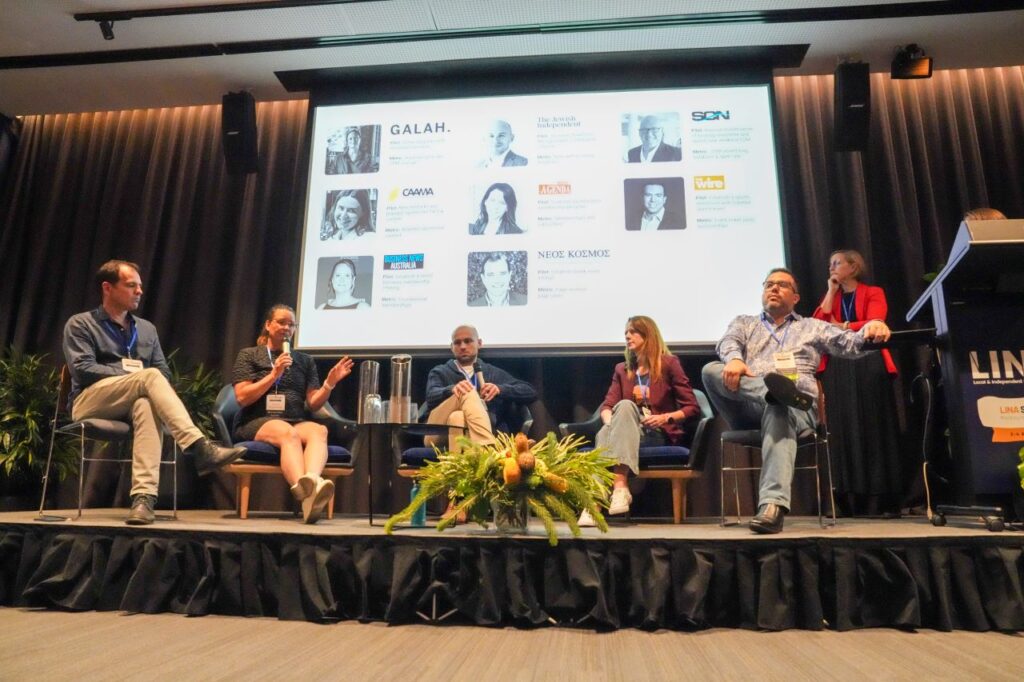
Successful business models around the world
Miguel Loor – Sembra Media
Miguel Loor (Sembra Media) shared insights from news businesses in South and North America and Europe and business models and income streams that are working in other jurisdictions.
2025 Debate and final plenary
Various speakers
A debate on whether AI would erode public trust in media featured teams arguing for and against, with the negative side ultimately winning audience support. Their key argument was that AI itself cannot erode trust, only people misusing it can do so, while proper AI implementation could enhance journalism.
During the final plenary participants shared key takeaways and future actions.
- Implementing new tools like BroadStreet Ads
- Exploring AI applications for content
- Adding young journalists to boards
- Developing clearer mission statements
- Refining media kits
- Building collaborative relationships
- We are stronger together, keep in touch with each other and with LINA on issues in your regions
Workshops and discussions
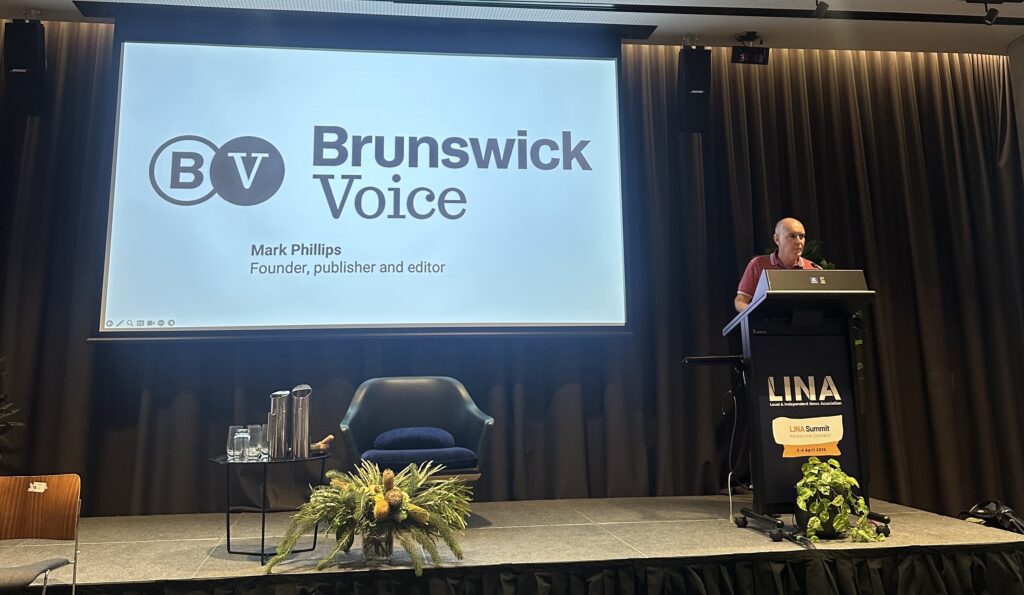
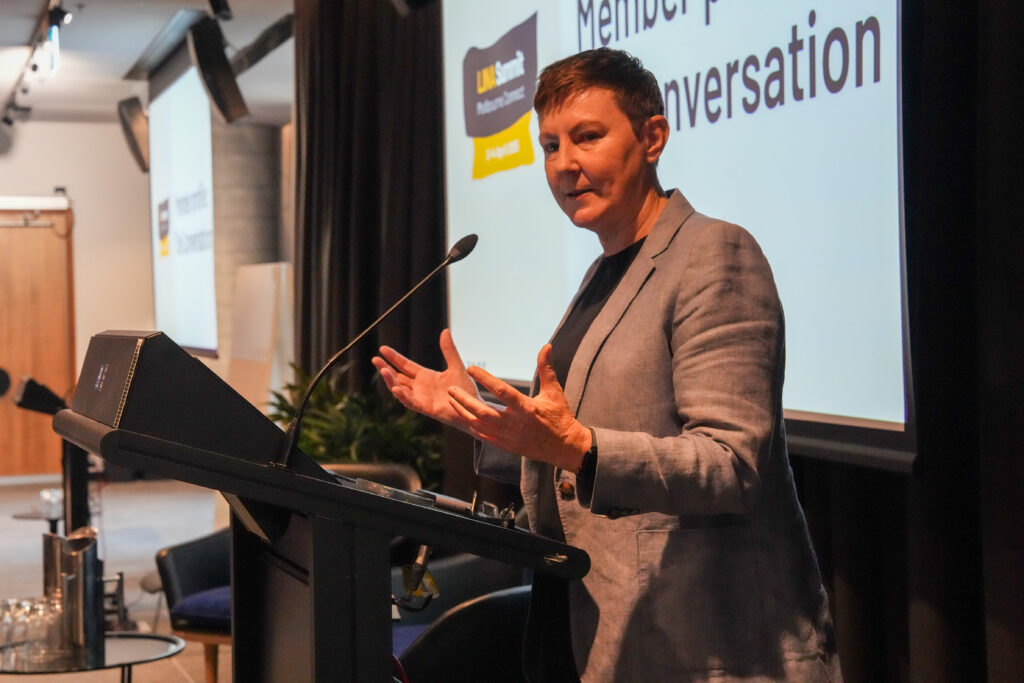
Member profile presentations
The Westsider


Brunswick Voice

The Conversation

With gratitude to our event supporters












With the kind support of
LINA partners