
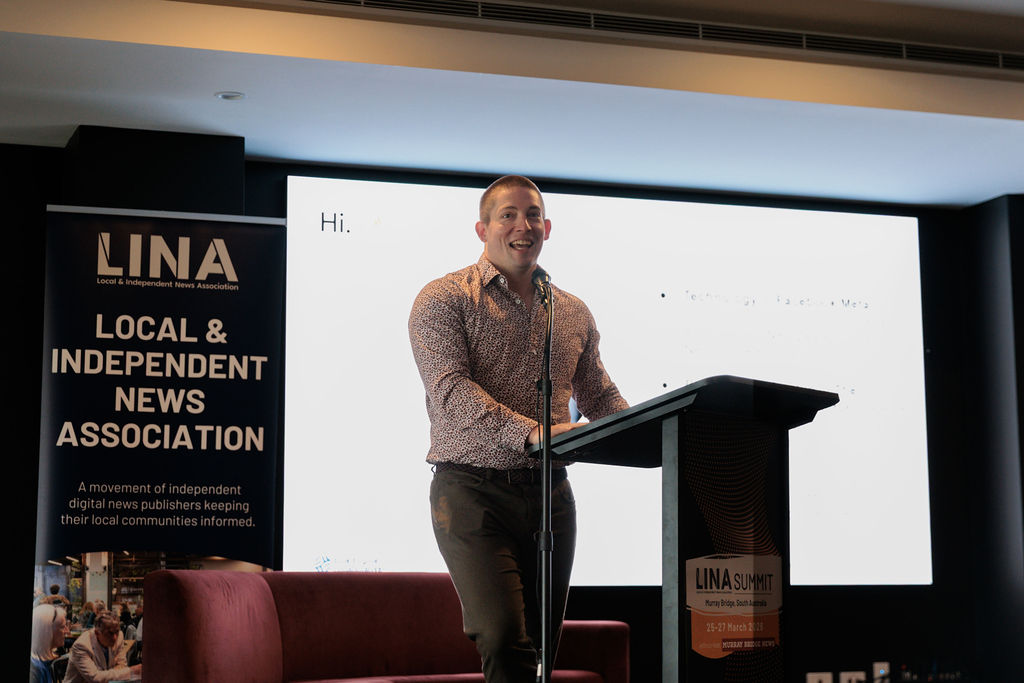
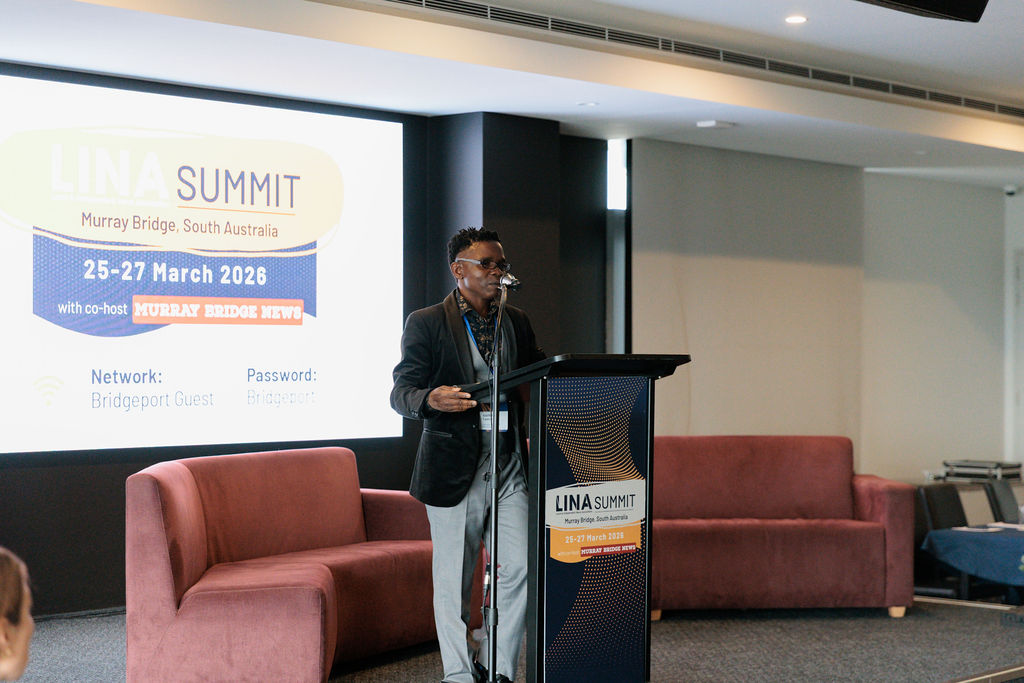
The fourth annual LINA Summit for local and independent news publishers was held in Melbourne, Victoria, in March 2026. We’ve compiled key takeaways and tips for newsrooms from each session, with topics ranging from news, civility and democracy, to digital ad sales, reporting during emergencies, newsletter growth strategies, media policy and far more.
Sessions by category
- The only way is up: Day 1 plenary.
- The side doors are closing: Day 2 plenary.
- Impact driven scaling: Deep Dive.
- Revenue ready newsletters.
- Copyright and generative AI update.
- Feeds to front pages: creators and newsrooms.
- S.I.M.P.L.E Visibility for newsrooms.
- Audit to action: newsroom sustainability.
- NewsREAM: Turn listings into revenue.
- How to pitch advertising to people who don’t understand digital.
- Platform Collective: Group advertising project.
- Asks that work: fundraising.
Session summaries
Presentation slides available to LINA members only.
Deep Dive Workshops
Impact-driven Scaling
Blue Engine Collective – David Grant
Need to grow your news business but not sure how? Develop a sustainable growth strategy that is manageable for small publishers, informed by the learnings of over 400 newsrooms globally.
David Grant, Blue Engine Collective, provides a practical guide for how to grow your revenue and your audience
Define the area of most impact for your newsroom and start scaling up!
Deep Dive: Revenue Ready Newsletters
Inbox Collective – Dan Oshinsky, LINA – Adam Weatherhead, LINA – Adrian O’Hagan, The Conversation – Margy Vary
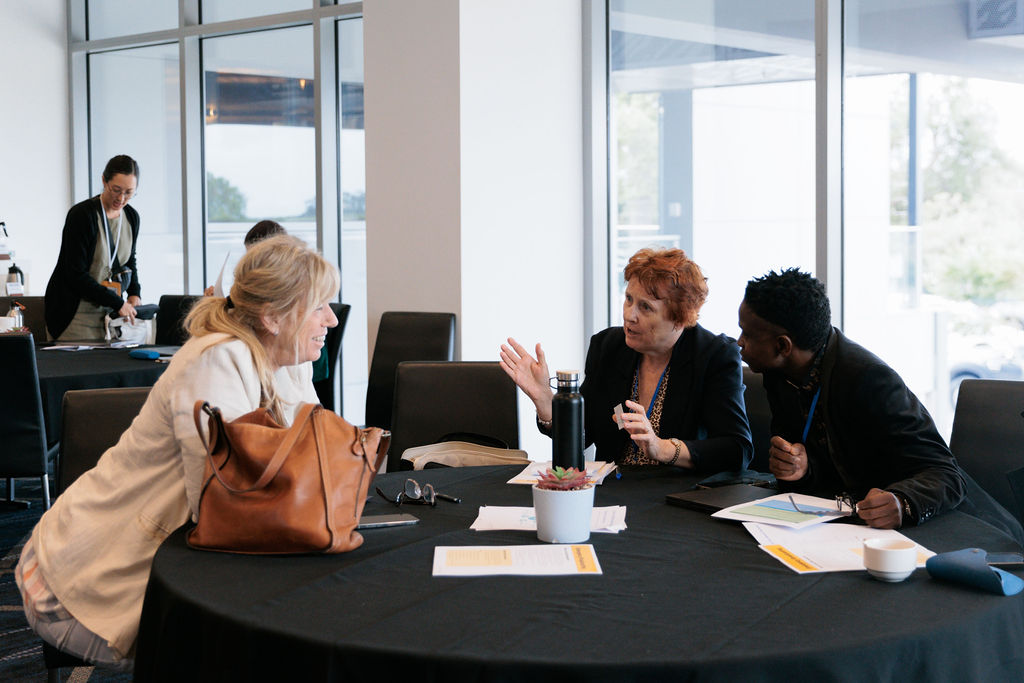
Make impact in the inbox and own your audience engagement in this one-day deep dive on newsletter strategy.
Start to finish newsletter strategy, best practice audience engagement, segmentation techniques, A/B testing advice, revenue development. Hear from publishers doing this well. Get advice on software tools to help build and distribute your newsletter and manage your database.
- Readers expect a lot more from you and your newsletter
- Just having an email address doesn’t mean your newsletter will reach your reader – mail privacy program
- Newsletters are not just marketing for your content and brand. You’re creating a community – sharing stories, making connections, driving action.
- Tools: Sparkloops, viral loops – Beehive and built in referral link tracking.
Best practice:
- Send from a person – the ‘voice’ of the community
- Help readers understand what’s happening nearby and why
- Your newsletter might help locals find free or cheap things to do. Build products that serve people. Teach something new.
Driving revenue:
- Make sure your voice is in everything you send
- Show readers the value you bring to the community, “Will you join in and help telling important stories?”
- Send a one-off email, at least once per month. Some random thing.
- Self serve ads – classifieds, jobs boards, event listings, useful for readers.
- Supper clubs – eg $185 secret venue announced week of event. Only members can go. Eg. fun run event, merchandise, beer passport for venues, snail mail pack $140 per year for quarterly stickers etc.
- Create gatherings in your community – eg happy hour for a launch, bring people together so they can meet, fundraise for a local eco group.
- Show up and talk to your audience – meet people where they are
- The Squiz – good example of referral program. Give people a giveaway entry in return for a referral. Incentivise people to share with 1 friend.
Lessons:
- Start with the resources you have – simple guides, friends, build
- Keep things simple for as long as you can – learn, iterate, don’t overcomplicate
- Use your voice in everything you do
- It only works if it works for you – it only matters if it works for you and your community.
Video Journalism
DailyMotion – Jean-Baptise Alary
This hands on, full day workshop takes us through how to create, distribute and monetise video news content.
- Magic Links – for getting around password protection for paywall, no need to put a PW in, it just sends a login link to your email that works for 15 mins
- Use Claude AI (Cowork mode) to clipfarm – upload transcript and video file, and tell AI to identify key 90 sec clips from the larger video.
- Leave talent on screen for as long as name super is needed – 2-3 secs max
- Piece to camera: use info that you found out during the day
- You can never have too much b roll
- Keep voiceovers to one sentence – be ruthless and concise
- Make sure your shots change every 2-3 seconds – keep it snappy
- The more interviews the better – viewers want to see speakers
- Capture the story well enough visually that if they couldn’t hear you, they could still understand
- Shoot the video like an editor – shoot videos including b roll in order of the video you’re going to edit
- Find a way to monetise videos through sponsorship, advertising, affiliate, subscription, on-site hosting,
- Start with the audience not the brand, create repeatable formats, let brands support the story
- Nail your hook. Inject personality. Kill your darlings (be as concise as possible, and don’t get too attached to shots). The silence test (many people watch on mute. Is it clear what the video is about if the first few seconds are on mute). Finish with the actions (what was the purpose of your video).
- Advertorial videos: make sure you’re aligned with the client (purpose, what videos of yours they like, audience, production, creative style, strategy).
- Be transparent: “This is a paid advertisement in support of local news … that allows us to provide local news for our community … thank you to X brand for supporting us”
Keynotes
The only way is up
Blue Engine Collaborative – David Grant
The other side of local news’ decline? Opportunity is all around us. David Grant looks at how publishers are going on offense with new products and services, and, gasp, marketing, to do something many even within our field think is impossible: grow.
- Our competition isn’t other news publishers, it’s non-consumption.
- ‘Updates’ are not enough, think about building community and serving other audience needs.
- If you’re not working with trusted local creators you’re choosing a smaller audience (Kelly Nelson)
- Let your people shine. Find their strengths to create products that fill niches.
- Consider partnering with local creators.
- Consider your audiences needs beyond information, and how to serve them.
- Consider expansion of news service into other localities.
The side doors are closing
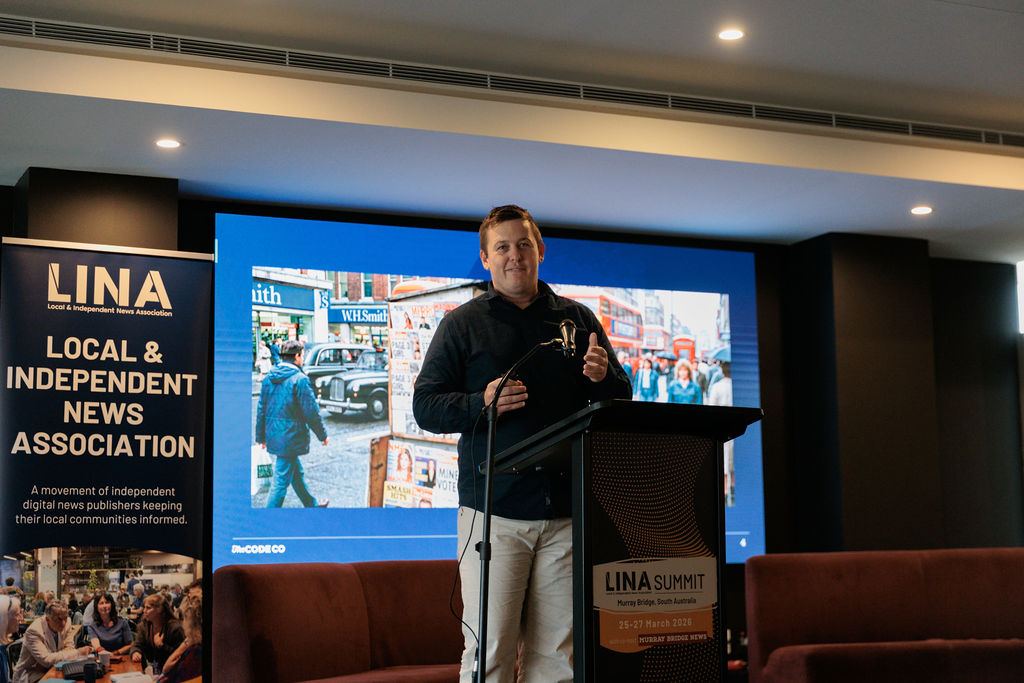
The Code Company – Ben May
For years, publishers relied on a quiet trick: pull audiences in through long-tail discovery and convert them into loyal readers. That playbook is being rewritten in real time. Ben May explores what’s shifting in how audiences find news online, which habits and channels are worth your attention, and how a small team can use the same technology disrupting discovery to build something more resilient.
- Use a user needs model to build behaviour: ‘give me’, ‘inspire me’ ‘connect me’ (all still outside the scope of AI).
- People want unique, human specific things – genuinely distinct, emotional resonance
- You don’t need to build tools from scratch, just use what is already there.
- Stop thinking about AI as a product, instead as an automation.
- Find the thing that builds behaviour, and position it next to your journalism (like horoscopes).
Presentations – Day 1
Copyright and Generative AI Update
Copyright Agency – Lucinda Gardiner
Lucinda Gardiner provides an update on the Copyright Agency’s advocacy work to protect copyright holders from AI companies and opportunities for publishers through Copyright Agency membership.
- Copyright Agency represents creative types – negotiates copyright agreements for fees and sending them to rights holders
- Photocopiers used to be a disruptive technology… (AI)
- Our copyright does not need to be watered down: if people have had their data used, they should be paid in commission costs.
- Join the Copyright Agency! It’s free, and non-exclusive, meaning you can use your content as you want.
AI Builders Lab
Other Labs – Chloe Brice & Jenni Ryall (Other Labs)
In this session, publishers started from wherever they were at (cautious, overwhelmed, neutral, or excited), treated their journalism skepticism as a strength, used low-stakes play to reduce fear, learned structured prompting (persona + task + context + format), followed key guardrails (hallucinations, bias, and privacy—with human oversight and a simple policy), and then built a simple Gemini “Gem” newsroom assistant as a bridge from play to piloting and implementing it in their workflow.
- “Play” is the foundation: use low-stakes experimentation to reduce fear and build comfort, then move from play → pilot (focused testing) → implementation in real workflows.
- Think of AI as a “super tool” that can improve efficiency across many tasks (not just “another tool”)—especially helpful for small newsrooms juggling newsletters, social, events, sales, and production.
- Better prompts get better outputs: generic prompts produce generic, cliché-heavy, similar-looking content; using a simple structure (persona + task + context + format) leads to more useful results.
- Maintain strong guardrails: expect hallucinations (especially with names and numbers), watch for bias (it mirrors the internet), and protect privacy—avoid uploading sensitive material on free tools.
- Keep humans in the loop: AI can support workflow and drafting/structuring, but editorial judgment, verification, and integrity stay with people (and it helps to document a simple one-page policy covering transparency, privacy, and oversight).
- Keep experimenting in a low-stakes way (“play”) to build comfort, then move what works into a pilot (focused testing) before you implement it into your day-to-day workflow.
- Take one repeated task from your newsroom/business and turn it into something simple in Gemini (for example, a basic “Gem”/assistant), then refine it by tightening your prompt (persona + task + context + format) based on what you learn.
- Put lightweight guardrails in place right away: document a simple one-page AI policy and stick to human oversight—verify outputs (especially names and numbers), watch for bias, and avoid uploading sensitive material on free tools.
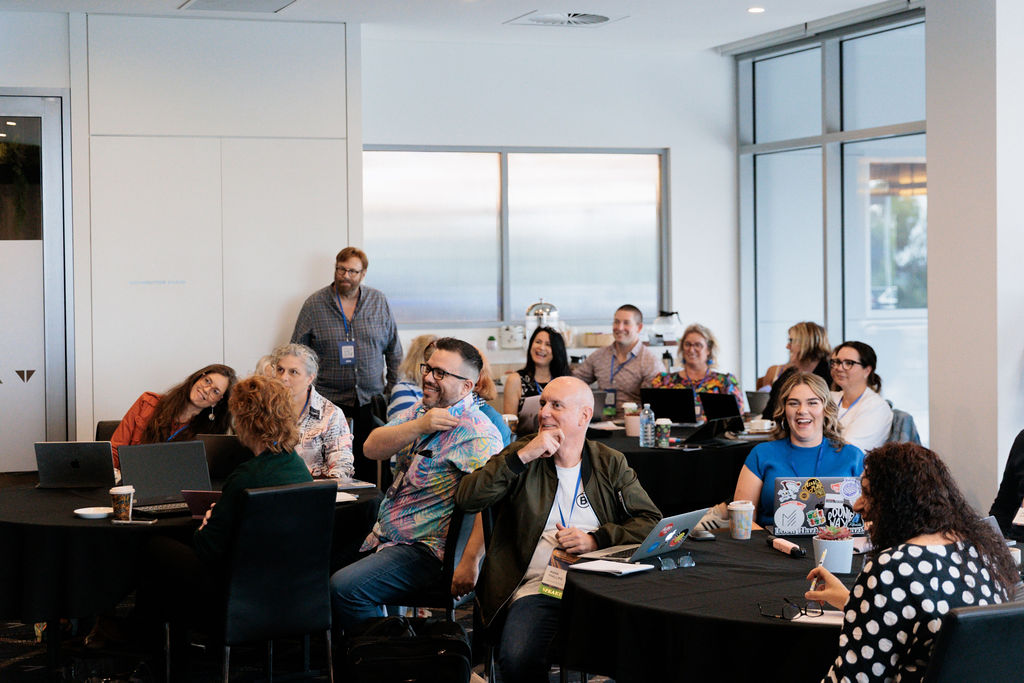
Community listening
Commshake Media + Engagement – Courtney Blacker, Murray Bridge News – Peri Strathearn, Michelle Surowiec – LINA
What do we want? More news! How do we want it? Good question!
In order to grow, news organisations must be of service to communities. Demonstrating value is a cornerstone to scaling news businesses and how publishers can deliver news that serves to strengthen sustainability. This session explores how newsrooms can engage their stakeholders to understand their needs.
- Suds and Civics: went to different laundromats to have community conversations. Huge engagement hit for them.
- Citizens Agenda: a model of election coverage where votes set the agenda for the election.
- Think of having a physical presence in public places for engagement. Meet people where they are already.
- Leverage connections, issue direct invitations, keep asking. Advertise, offer incentives.
- Find collaborators, be present before you ask anything, especially with underrepresented audiences. Listen first.
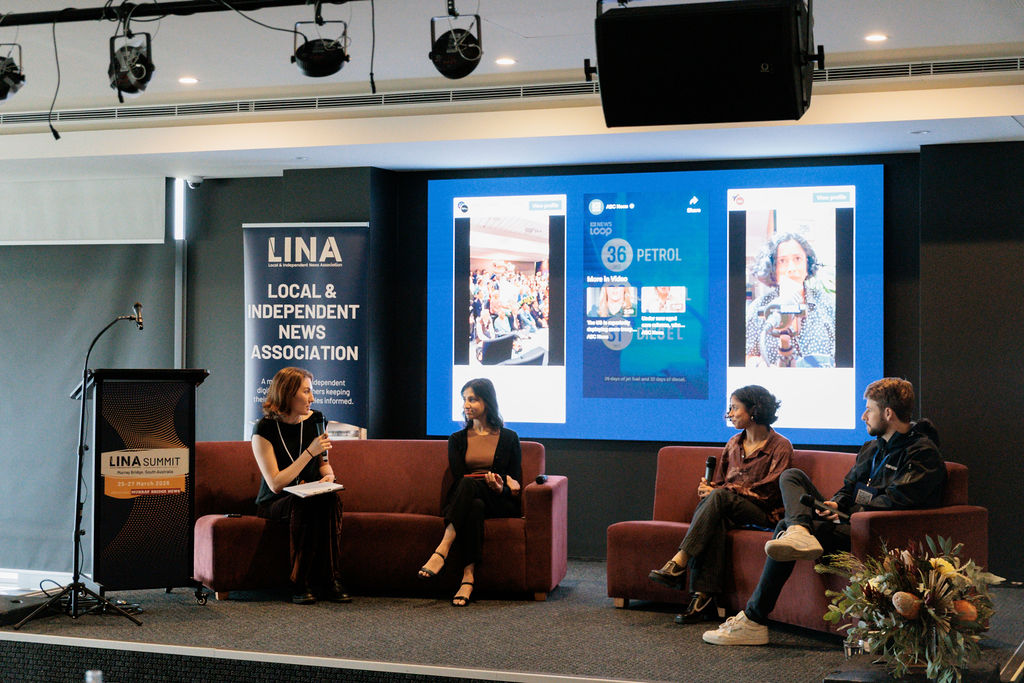
Feeds to Front Pages: Creators and Newsrooms in Conversation
Draw Your Box – Alicia Vrajlal, ABC – Luke Radford, McAuliffe & Khopkar – Anisha Khopkar, Nell O’Shea Carre – LINA
This workshop explores strategies for effective collaboration between newsrooms and content creators to better serve audiences with impactful storytelling.
- Your journalism can be accurate and important, but if it’s boring, it won’t succeed on social media.
- Content creators are an avenue for promoting your content to new audiences, but you need to think carefully about protecting your own brand and be realistic about what can be achieved through partnerships.
- If you’re not partnering with your local creators you’re not reaching everybody in your community. Find something that you’re both passionate about and treat them as partners, not as competitors.
- Content creators don’t necessarily understand journalism. This can be a risk if it jeopardises your audience’s perception of your brand. It can also be an opportunity to provide training on structuring an interview or an experience of working in an editorial process to creators as part of a value exchange.
- Never assume that by partnering with a creator you’ll reach their whole audience – somebody with tens of thousands of followers is only likely to bring a small fraction of them into any partnership.
- You may be better placed engaging a content creator to assist you with building up your internal capacity to participate in social media.
- Being successful on social media means understanding the unique characteristics of those ecosystems. Content should have an immediate hook – grab people with an interesting question, suggest a mystery, or say something bold. Be authentic and be interested – audiences will see through fakes.
- Be aware of platform dependence – you don’t own audiences on platforms that you don’t control. Social platforms are great for discoverability, but for retention, make sure you’re guiding people toward your newsletters or your website.
- Identify the local content creators in your communities and introduce yourself to them.
- Consider how content creators could assist your communication goals, help you to reach new audiences, or produce new content.
- Develop internal capacity to regularly engage on social media. Ad-hoc engagement is rarely sufficient to build an audience.
- Prepare a strategy for converting your social media audiences into newsletter audiences.
Bio-hacking for stress management
RMIT – Bonnie Shaw
This session helped participants understand what stress does in our bodies and practical steps we can take to unwind those pressures without adding to our task list. Using a data-informed approach to stress management in frontline workers, Bonnie shared insights from different workplace settings that are applicable to the news environment to help publishers learn about the cognitive and behavioural impacts of chronic stress and data-driven approaches to stress management and performance enhancement.
- We are experiencing a time of massive change. Cognitive scaffolding can help us work amid crisis.
- Chronic stress limits our capacity for innovation and creativity, while undermining our capacity to think our way out of it.
- It’s not stress that does damage, it’s how we respond to it.
- Methods for managing the space between a stressor and our response can include: physical exercise, sleep (even tactical napping), digital detox, nutrition, community connection, automations, cognitive practices, planning and preparing and using the body as a tool (eg deep breathes)
- If there are ways to automate what you’re doing – get it off your plate.
- Test our physical reactions, thoughts, emotions and behaviours. As yourself why you’re responding in the way you are.
- “Between stimulus and response is space. Space is choice. In choice is freedom.” – Victor Frankl. Stimulus (stressor) > protect this precious space for metabolising stress < respond.
NewsREAM | Turn listings into revenue
Newsport – Sam Cullen
This hands-on workshop explores NewREAM, a new service from LINA that helps publishers turn local real estate listings into revenue.
Newsport demonstrates NewsREAM in action, we hear from pilot publishers about their successes, and learn how to activate listings through editorial coverage. This includes workshopping editorial story ideas, building local real estate relationships and angles to get your newsroom started so you can hit the ground running.
- The real estate market is always growing: it’s a $12 billion so room for more platforms
- NewsREAM is not trying to be like domain or realestate.com: instead offering a trusted platform and audience that complements the property website.
- Simple to implement. Multiple revenue streams.
- Build authority, develop relationships, demonstrate ROI. The more agents are shown, the more they soften to the idea of your site being a respected method of sale.
- Contact Adrian to get started with NewsREAM.
S.I.M.P.L.E Visibility
Jenn Donovan
Social Media and Marketing
Local news is more important than ever, yet today’s fast-changing digital world has made it harder to maintain the close community ties newsrooms once enjoyed.
This session focuses on simple, doable actions that help your newsroom become visible, valued and actively supported, without adding more platforms, more content or extra overwhelm. It’s designed for regional publishers who want practical steps to re-engage their audience, strengthen relationships and build a loyal supporter base.
Together, we explore how to move beyond a one-way “broadcast” approach and reconnect with your community in ways that feel genuine, inclusive and aligned with the heart of local journalism.
- You don’t need more content, you need more visibility.
- Show up, invite engagement, make it human, provide value, leverage community, prioritise value, encourage action.
- Lean into the value of being a local face that people know and trust.
- Get into the community and engage with locals on a consistent basis
- Display easily how readers can support you – ‘support local journalism’ messaging, ways to donate, ‘buy me a coffee’ method
- Don’t just sponsor – DO! Show up to the local barbeque and join in, show up to sports events and chat to people, even when you’re not reporting
Audit to action
Blue Engine Collaborative – David Grant
How sustainability assessments can drive meaningful change in your newsroom.
Learn how to undertake a sustainability audit and make the most of the recommendations to strengthen the overall sustainability of your news business. This session provides pathways and support to implement focus actions.
- A benchmark is the average of someone else’s choices. You will be above it, at it, or below it. This doesn’t necessarily tell you anything useful.
- A lack of reserves leads to a short financial runway for organisations. The top 20% of newsrooms in the US can support themselves for approximately 6 months.
- Businesses need to spend 2-3% of their annual turnover on marketing to grow.
- Publishing on vibes is over – use your analytics.
- When considering expansion opportunities, ask yourself, who else can we serve?
- Build your cash reserves
- Use your analytics
- Consider who else you could be serving
- Spend some money on advertising to let people know you’re there.
Choosing a Not-for-Profit Structure
LINA / CBAA – Jon Bisset
This session explores the main not-for-profit structures available to news organisations, including the pathway to charity registration. We weigh the pros and cons of each model, from governance and funding access to regulatory obligations, so you can decide what structure best fits your mission and growth plans.
- The question ‘Should we become a not-for-profit’ is often the wrong one. Instead ask yourself what you are trying to build, do you want to return profits, do you want to act in the public interest?
- Your answer to those questions should inform two different decisions – your business structure (for profit or not-for-profit) and your business model (commercial entity, social enterprise or charity). Don’t try to fix model with structure. Becoming a not-for-profit is not an immediate fix to the problem of not having enough revenue as a commercial entity.
- Not-for-profits can, in fact, make a profit, they just can’t distribute it to members. Charities are not-for-profits that operate for public benefit.
- The benefits of not-for-profits are that they are purpose-led, they have a greater capacity to pursue and protect their missions, they tend to attract higher public trust, and they can access grants, gifts, bequests and have a social license to use greater volunteer labour. The downsides are that they have high governance burdens and tend to be slower at making decisions.
- Deductible gift recipient (DGR) status allows a charity to receive tax-deductible gifts. DGR status is very difficult for news organisations to obtain in Australia, and few have achieved it. Without DGR status, a charity’s ability to access philanthropic grants, gifts and donations is limited.
- Australia does not have the same culture of giving as the United States and our philanthropic sector is much smaller. Philanthropists may not understand the news sector, and publishers may not understand philanthropy. Building and maintaining relationships with donors is a crucial part of running a not-for-profit.
- Consider a social enterprise as a third option – you can be a mission-driven, for-profit social enterprise.
- Ask yourself what you want to achieve as a newsroom, and determine the appropriate business structure based on that.
- Review potential sources of philanthropic funding – what types of things are funded, at what quantum, over what time period?
On the Front Line: Reporting Before, During and After Emergencies
Emergency Broadcasting and Regional Radio – Anthony Gerace
As floods, fires, cyclones and extreme weather events become more frequent, newsrooms are increasingly required to report while living through the emergency themselves.
In this practical session, Anthony Gerace shares best practice reporting during crises, with a focus on keeping communities informed and safe. Drawing on real-world experience, the workshop covers emergency preparedness, trusted information sources, useful contacts, and clear guidance on what to publish when conditions are fast-moving and high-risk. The session also looks at recovery and follow‑up reporting once the immediate danger has passed.
- Emergencies are life-threatening events (primarily natural disasters, but also pandemics) that threaten lives or pose a risk of significant property damage. They are increasing in frequency and complexity.
- Making sure that you are prepared for, rather than reacting to, an emergency can save lives.
- There are important things to do before, during and after an emergency:
- Before
- Have a personal plan (comms, check-ins, go bag)
- Have a professional plan (risks, contacts, business continuity plan)
- Know your local emergency agencies and alert systems
- During
- Safety first (PPE, manage fatigue, teamwork if possible)
- Share accurate, verified info
- Use trusted sources, avoid sensationalism
- After
- Focus on help, recovery, and solutions
- Keep public informed
- Hold authorities accountable
- Be mindful of trauma
- Read through the emergency reporting materials on the LINA website.
- Create a personal emergency action plan.
- Create a professional emergency action plan.
- Familiarise yourself with local emergency agencies and alert systems.
How to find an expert source
The Point | The Australia Institute – Anna Chang, Nature Media Centre – Tracey Ferrier, Nell O’Shea Carre – LINA
Resources and spokespeople at your fingertips to strengthen your stories.
The Australia Institute discusses their news service, The Point, available free for publishers to republish content that complements and/or enhances local reporting. The AAP describes their newswire service for newsrooms, including significant discounts for LINA members. The Nature Media Centre shares how they, and other media centres, can help you source expert sources for stories, spokespeople with lived experience, and case studies. Everymind (Mindframe) shares resources to inform responsible reporting on mental health and suicide.
- Media centres exist to connect journalists with experts. Visit the Nature Media Centre, Economic Media Centre, Climate Media Centre, or Australian Science Media Centre to connect with experts to help tell your story.
- Australian Associated Press has a national news wire including video services, court reporters and photographers, and sports photographers. They work with LINA members to come up with pricing more affordable for smaller publishers.
- The Australian Institute has launched The Point, an initiative to help readers make sense of the most important issues affecting them today. The content is freely available for syndication.
- When covering stories about suicide, mental health problems, and addiction- framing, details and language are key, especially at the local level. Mindframe can provide journalists with free, real time support in covering these stories.
How to pitch advertising to people who don’t understand digital
Western Sydney Publishing – Troy Dodds
A short knowledge-sharing session with a LINA member publisher.
- Local businesses are likely to be the majority of your advertisers.
- Converting people to digital advertising can be difficult due to a general lack of understanding of what ‘digital’ entails; the ongoing effectiveness, trust and visibility of print channel advertising and a view among some clients that being present on social platforms is sufficient as digital advertising.
- Overcome these challenges by offering a combined package first. Offer digital and contra-partnerships to existing print advertising clients to aid that conversion and then win them over with the results.
- Never suggest that advertising is about choosing between one channel and another. Present each as an additional, mutually beneficial platform: use print to build the brand and digital to sell the product.
- Create original digital positions for your clients. Positioning your advertiser as the ‘Local Authority’ in their sector is a proven method that not only helps with results, but with renewal as well.
- Key sales techniques include showing them ad placement on a device in person; show another client’s results; get testimonials from existing clients; regularly brainstorm objection responses within your sales team and price at a premium and discount from there.
How to publish smarter in a fragmented world
WP Engine – Rob Stinson
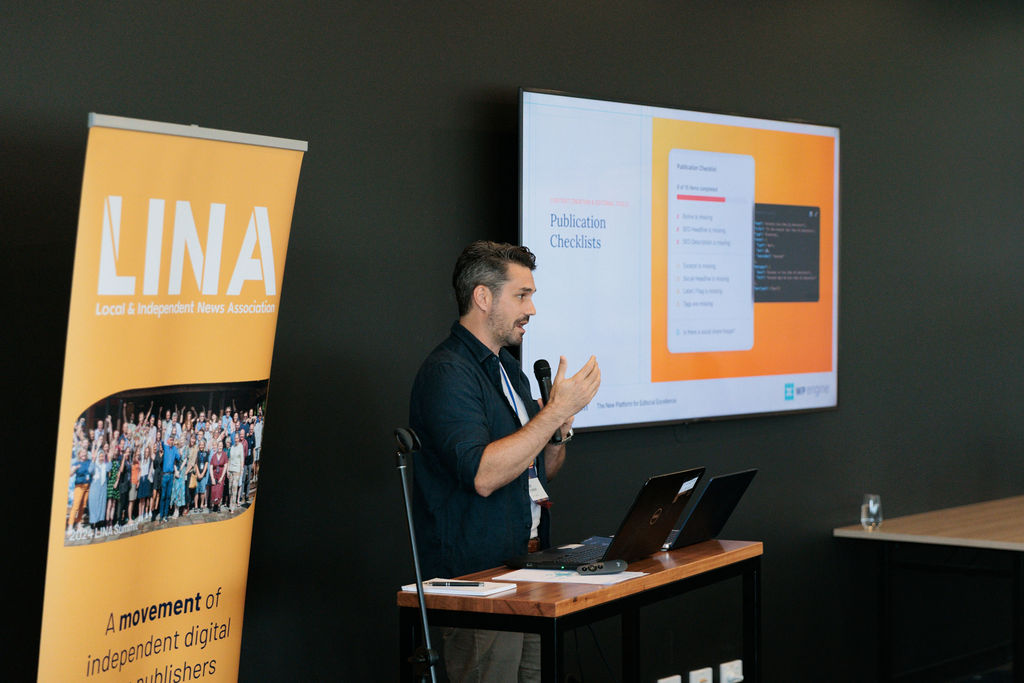
An introduction to the Newsroom platform with WP Engine to optimise your editorial workflow.
Newsroom is the platform that replaces fragmented publishing systems with a unified foundation for modern media growth, allowing teams to publish smarter and faster by WP Engine. Come along if you’re using WordPress or curious about changing platform.
WP Engine features:
- on page SEO
- newsletter writing
- content syndication
- programmatic ads
- post scheduling
- editorial checklists
- content analytics
- rich insights
- donation management
- breaking news
- digital asset management
- search
- translations
- revisions
- Reach out to Adrian if you need support implementing WP Engine or other website queries.
Journalism Growth
Google – Lais dos Santos
This Google News Initiative session provides a practical guide for journalists to integrate AI into their daily workflows.
Participants will learn to enhance content creation using tools like Gemini Canvas, Veo for video, and Lyria for audio, while mastering research and verification using Deep Research, Pinpoint, and NotebookLM for deep document analysis. Beyond drafting and multimedia, the session covers critical skills in identifying AI-generated content with SynthID and safeguarding newsrooms against cyber threats, ensuring technological growth pairs with editorial integrity and resilience.
- You can now move beyond “generic” AI by creating “Gems”—custom assistants trained on specific article structures and style guides to automate the repetitive parts of the editing process.
- PinPoint allow journalists to analyse huge data leaks or archives—including photos of handwritten notes—and will transparently admit if they cannot find a specific piece of information.
- Notebook LM is particularly effective for news agents looking to build detailed audience personas or repurpose existing long-form articles into new formats like video scripts or podcast outlines.
- Schedule a 15-minute 1-on-1 session with Lais and fill out the lab sign up form to receive a personalized strategy for integrating these tools into your specific newsroom workflow.
- Take your organisation’s style guide and use it to train a custom Gem assistant for headline generation or basic copy editing.
- Upload a collection of local government documents or historical archives to PinPoint to test its ability to transcribe handwriting and identify key entities.
Platform Collective | Group Advertising
LINA – Claire Stuchbery
Across Australia, independent newsrooms reach deeply trusted audiences at the heart of their local communities. Platform Collective turns that collective strength into scalable national advertising revenue.
At the Summit, we demonstrate the full commercial engine from brief to booking, ad serving to reporting, and invoicing to publisher payment. We unpack the commercial agreement, revenue model, and governance framework so you understand what participation looks like. If you’re ready to move beyond one-off local buys and capture coordinated national revenue, this session will show you how.
- National advertising agencies are very unlikely to make individualised bookings with publishers.
- Platform Collective addresses this issue. It is a group advertising purchasing platform that supplements your local advertising sales with national campaigns, particularly those from federal and state governments.
- The platform uses Broadstreet to see and allocate unused inventory and for campaign reporting.
- LINA has been working with a major advertising agency to prototype and test the platform and to ensure that it meets the needs of their clients.
- Onboarding to Broadstreet is a key step in participation. It allows us to forecast inventory, deliver campaigns seamlessly through a single ad-serving platform, report accurately, and scale with confidence. Book in a meeting with Adrian to get started.
- LINA is preparing the commercial agreement to present to members and ensuring that the appropriate support staff are in place to run the service.
Show and Tell
Tasmanian Inquirer – Bob Burton, Central Coast News – David Abrahams, Mindframe / Everymind – Elizabeth Paton, LINA – Adrian O’Hagan (on Cloudflare), Sembra Media – Miguel Loor, Hericom Media – Harry Taruva
Ten brief ‘lightning’ talks on things that are working for publishers and others in the industry.
- Chrome extension tool ‘Sky Follower Bridge’ allows you to find X followers on Bluesky
- Contact state leads at ABC for attribution of story sources, quote their own editorial policy “do not misrepresent others work as your own”.
- Don’t be afraid to look backwards – your community classics are waiting to be told. Remind your community where you came from
- Explore global media directory and reports globalprojectoasis.org and subscribe to sustainable media newsletters.
- AI use examples: Data storage, reader analytics, understanding SEO, how to spot bogus copyright claim etc.
- Small newsrooms are disproportionately targeted by state-sponsored DDos attacks and expensive “bot traffic” that inflates server costs. Apply for Project Galileo – free tools to protect newsrooms from online attacks. Reach out to LINA’s Adrian to discuss tech tools to support your newsroom
- Consider partnering with community radio stations to present radio bulletins – mutually beneficial and revenue opportunities – sell it to community or commercial radio station
- Free setup for LINA members to implement Potent Puzzles. Contact LINA or Lukas on 0418 427 114 to access puzzles to use in your publication
Presentations – Day 2
Publisher Profile – IndyNR
Susanna Freymark
Susanna Freymark shares her work around the Northern Rivers region of NSW.
- To survive as a local news agent, you must offer more than just facts; you should produce storytelling products that stop people in their tracks and compel them to listen.
- ‘Advertising with heart’: get local businesses on board with your mission.
- Storytelling is not just news, it’s all other media products as well. Could include themed events (like the Brenda themed ‘Beef Week’, in memory of a local legend) and movie screenings
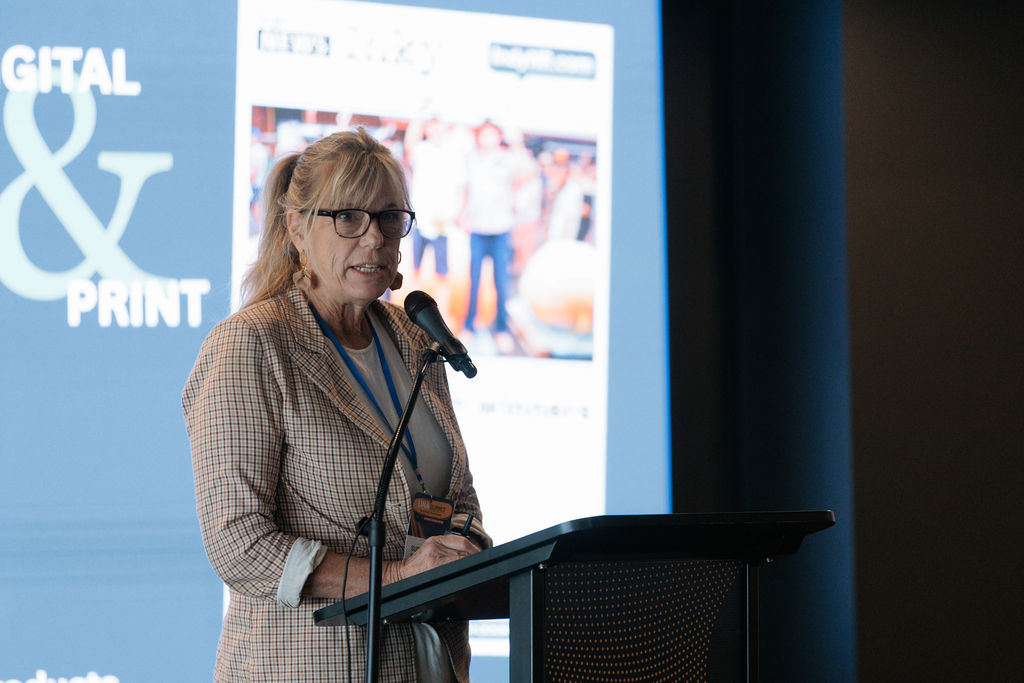
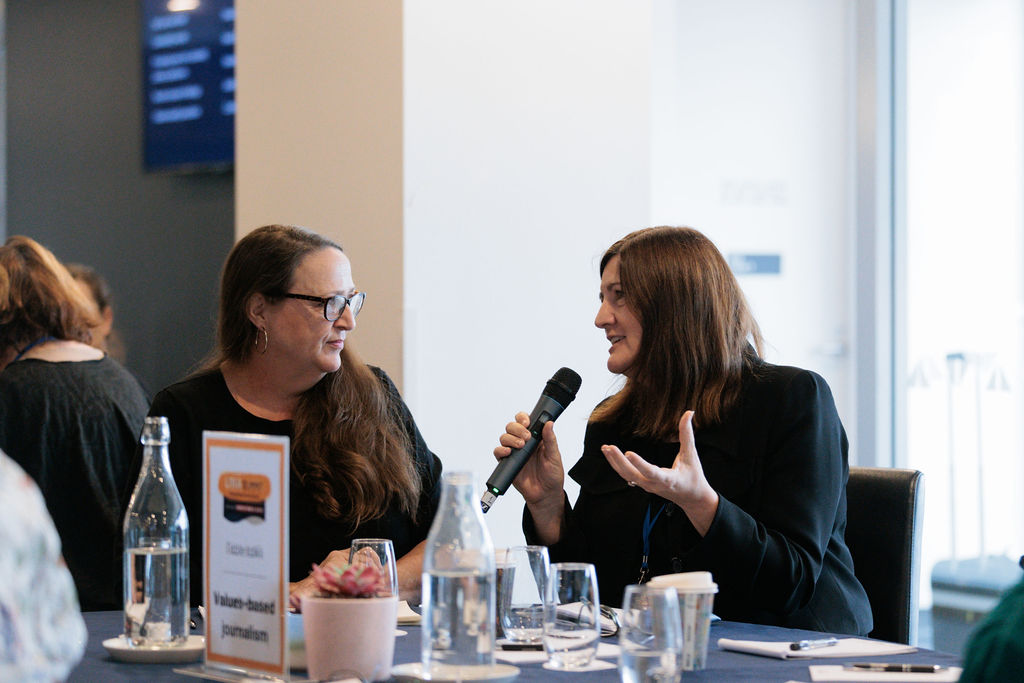
Table Talks
Attendees could choose a discussion group to join, with topics including values-based journalism, recent research findings, producing news for culturally diverse audiences, and more.
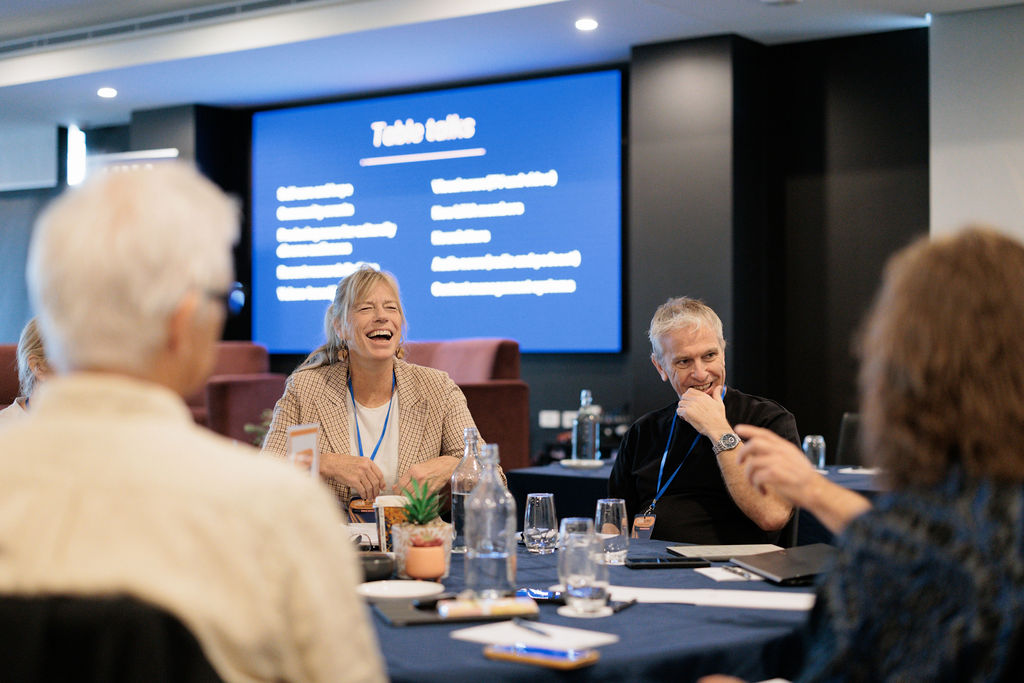
Asks that Work
Balanced Effect – Tammy Schlitz, Press Patron – Alex Clark, The Conversation – Louise Cornege
This practical workshop covers fundraising strategy, hear examples of standout messaging, smart use of giving tools and clear calls to action. Run a clear, multi-channel fundraising campaign (especially driving monthly giving), personalise and time asks, and follow through with strong donor gratitude and reporting-back to sustain support year-round.
- Reframe the “ask” as a value exchange: your journalism is valuable, and it’s okay—and necessary—to clearly invite the community to support it.
- Be extremely clear and direct about the action: explicitly ask for a financial contribution (ideally a monthly gift), avoid vague or multiple competing calls-to-action.
- Create urgency with a defined campaign window: a short, bounded drive (e.g., six days) makes repeated asking more acceptable and helps people act before time runs out.
- Use multiple channels and multiple touches: emails, socials, website takeovers/pop-ups/banners, and other placements—because people won’t all see the message in, and repetition matters.
- Personalize the message and show impact: explain what makes your outlet unique, share concrete outcomes your reporting enabled, and report back on what donations made possible (not just the dollar total).
- Treat gratitude and donor care as essential: send personal thank-yous (even to smaller donors), follow up promptly, respond to complaints thoughtfully, and keep supporters engaged year-round so they’re more likely to give again
- Join the Our News. Your Voice 2026 LINA collective fundraising campaign.
- Draft your campaign’s key messages now: define what makes your journalism uniquely valuable, the specific reason to donate, and one clear call-to-action that emphasizes a monthly gift.
- Build and schedule a short, urgent multi-channel plan: pre-promote the campaign, then use website placements (menu button, pop-ups/banners/widgets), email sends (and resends to non-openers), and social posts across the campaign window.
- Prepare follow-through: set up personal thank-you outreach (especially to larger and regular givers), plan how you’ll report back on what the funds enabled, and keep an evergreen donation/support option visible on your site year-round.
Managing Your Business Finances
Amy Moon
This workshop ensures you have the basics covered from tax management to superannuation obligations to basic accounting best practice.
- Advance the commission, but pay on receipt.
- Use 7 day terms, but chasing up after 30 days.
- Pay superannuation with contractors if they’re consistently employed.
- Gross margin is what you should pay attention to.
- write down the assumptions how many articles are being written, therefore how many people are paid etc. Hold onto those assumptions so you can work out later how you were thinking before.
- 6 months in the bank is ideal: contingency is important to have in case of emergency.
- If you don’t have a contract, a debt collector can’t really hold them accountable when it comes to advertising debts. They can then say that the costs of court will be much steeper than the small amount they will need to pay. Get a paper trail at a minimum!
- Put the date on the invoice instead of being a generic number of days.
- Make sure to pay yourselves.
- Go to your accountant and check how superannuation will be managed after July 2026, especially if Clearing House is involved
- Make sure to pay yourselves: this could also be important for government grant programs (e.g. the Journalism Assistance Fund).
News, Civility, Democracy
Menzies Leadership Foundation – Liz Gillies, Democracy – Tom Mooney, LINA – Claire Stuchbery
How can local news help rebuild trust and encourage respectful civic participation? This workshop looks at the relationship between journalism, civility and democratic health.
Drawing on international examples, participants explore practical models for newsroom-led civic engagement and consider how these could work locally. The session introduces the Democracy Counts campaign and surface opportunities for news organisations to adapt proven ideas and pilot projects at a place-based level.
- The work of local news is at the heart of local communities and essential to Australian democracy.
- The Menzies Foundation’s Civility Coalition project is making targeted interventions to support communities to be more autonomous and to be agents of change. In particular, they’re focussed on grassroots campaigning and embedding civic engagement inside local institutions: community foundations, local universities, chambers of commerce, local government and neighbourhood houses.
- McKinnon’s Democracy Counts campaign is calling for national civic reforms including an independent public service, media literacy education, social media regulation and investing in public interest journalism.
- Both organisations see local and independent publishers as being central to achieving their goals and to democratic health. News is the accountability and social trust infrastructure in our system and a key forum for open and responsible public debate.
- LINA is supporting these campaigns and will continue to engage on how to strengthen the role of news in our democracy.
High performance workdays
Donna McGeorge
How to get a ridiculous amount done in your day and do great work, consistently. This session covers topics like discovering optimum times of the day for new business, meetings, emails, and projects, and recognising habits that hold you back and rewiring them.
- We fall into behaviour traps like additive bias and status quo bias. Work is relentless, so overworking isn’t the solution- it just leads to burnout.
- Levers to pull to try and increase your productivity, and decrease your overload:
- Try to simplify, or “strategic subtraction”
- Build a strong foundation of good rest, good fuel, and movement (ideally ~30 mins, preferably outdoors).
- Leave a time buffer in your day for flexibility and creativity
- Work with your natural energy rhythms; the morning for deep important work, late morning for meetings, post lunch is for routine tasks and emails, final two hours is prep for tomorrow.
- Give yourself little 5 minute breaks after a 25 minute focus period.
- Basically do less, but do it better.
More Hands, More Headlines
LINA – Adam Weatherhead and Claire Stuchbery
Exploring ideas for recruitment, skills development and shared staffing models across independent news. Discussion of practical approaches to growing newsrooms capacity, entry pathways and models that are working.
- NSW LINA newsrooms successfully engaged young community members through Know Your Neighbour programs.
- LINA is working on its next shared service to support newsrooms, particularly with staffing/personnel challenges.
- Six options were put to LINA members for their feedback (see slides).
- LINA is to continue project planning following member consultation.
- Reach out to LINA if you would like to contribute feedback to inform the project development.
Seeing the Story: Visuals, Copyright and Context
ABC – Jessica Haynes, Copyright Agency – Lucinda Gardiner, LINA – Evie Dinkelmeyer
From photos to data visualisations, images play a critical role in how stories are understood.
This practical discussion explores best practice in image copyright with the Copyright Agency, effective use of charts and graphics with the ABC, and the tools and image libraries available to LINA members. Get a clearer sense of how to use visuals legally, ethically and creatively to support strong local journalism.
- Tell a story through the photos: the Odyssey format
- Illustrations are helpful when you don’t want identities shown
- Identify everything about where the images are coming from, who worked on it.
- Cover the copyright. Try to use internal imagery and designs, but credit regardless
- If you’ve changed an image, you should make note of that
- ‘Non-transformative clauses’ also mean you cannot use the image in AI training
- Moral right to be attributed as the author
- Have your own stock images of your own area, which are often reused
- Selfies from stories perform the best, or videos from phones. Also helps protect the audience from seeing images that are too confronting in some situations.
- Verification process has many steps, including confirmation of the people involved, checking the metadata etc.
- If a photographer has been paid as a staffer or a contract under an agency, they may not have copyright to give away.
- Get it in writing, stick to the licence as much as you can
- Check out LINA’s discounts for Getty images and AAP.
- Reach out to the Copyright Agency to discuss issues related to licensing etc.
Policy in play
City Hub – Lawrence Gibbons, LINA – Gary Dickson and Nell O’Shea Carre
What’s moving, who’s involved and where you fit.
An open discussion on the latest developments across priority media policy areas at a Commonwealth and State level. LINA and sector partners share what’s happening, what’s stalled and what’s next. This session invites you to respond, ask questions and consider how newsrooms can support, influence or engage with policy work that underpins the sustainability of public interest journalism.
- Key concepts behind recent submissions on the News Bargaining Incentive were shared.
- There was discussion of transparency requirements around any deals with tech platforms.
- Publishers discussed whether any deal is better than no deal under the proposed News Bargaining Incentive
- There was discussion of potential distribution models for any funds collected through a levy, with either LINA or the Copyright Agency as preferred administrators of funding.
- There was discussion of the upcoming competitive grant round, the News Innovation Fund.
- News Innovation Fund will open for applications in April.
- The industry is anticipating further consultation on the News Bargaining Incentive later in April.
- Publishers were broadly aligned in their views/input to LINA’s key points in advocacy on current issues. Limited diversion across the group.
Print is dead… Or is it?
Scenic Rim Media – Keer Moriarty, Brunswick Voice – Mark Phillips, The SE Voice – Lechelle Earl, Murray Bridge News – Peri Strathearn
This session examines the evolving role of print in a digital-first world, weighing the costs and benefits of newspapers and magazine formats.
Print has been written off as outdated, yet many publishers are doubling down while others are launching print for the first time. Hear why some outlets are abandoning print, why others are embracing it, and explore practical tools that can simplify print production and distribution.
- Print isn’t at its peak anymore, but it’s still being used in smart, evolving ways simply disappearing.
- Print can work as a marketing driver for digital: examples included using a printed “best of” (or teaser content with a QR/URL) to push people toward newsletters, subscriptions, and online reading.
- Publishers are experimenting with lighter/cheaper print formats (like short highlights editions or occasional newspapers) to reach audiences without the cost of a full traditional product.
- Print remains valuable for credibility and visibility in the community: being able to physically show a newspaper helps trust, recognition, and advertiser confidence.
- The main barriers are practical: rising costs (newsprint, freight), distribution challenges, and long lead times/deadlines—these pressures are forcing some publishers to pivot away from print.
- Hybrid alternatives are working for some: flipping from print to a flipbook + website can increase reach and add features like interactive ads, video on the front page, and faster corrections—while still keeping a “newspaper-like” product
- Use print deliberately as a bridge to your digital product: create a “best of” or highlights print edition (or teaser paragraphs) with clear calls-to-action like a big QR code/URL that drives readers to subscribe, join your newsletter, or read the full stories online.
- If full print is getting too costly or hard to distribute, trial a lighter hybrid model: move to a regular flipbook schedule plus website/newsletter, and add digital-native value for advertisers (interactive ads, click-throughs, even video on the front page).
- Tighten your print workflow and admin so it’s sustainable: adopt a simple planning/invoicing system (or another layout-planning method) to speed up flat plans, track ads, and reduce invoicing time, while keeping your preferred design tool.g., InDesign) for final layout
Website Bungles Bingo
LINA – Jennifer Reuter
Design your way to a better site.
With the help of a bingo card, we dive into the most common design bungles in websites and what to do if you find yourself in that unfortunate pit of poor contrast, confusing navigation and a pile of fonts.
- Good design is not noticeable, bad design is very noticeable.
- Make sure contrast is high enough for text to be visible against background colour
- Use symbol or shape to differentiate buttons, not just colour
- Use a dark grey instead of black in background so not as harsh, and make the text slightly thicker
- For colour scheme branding: 1 dark, 1 light, 1 primary, 1 highlight ‘pop’ colour, and 3 neutrals
- Steer clear of Arial, Comic Sans and Times New Roman
- Don’t just bold a heading – set it as an actual ‘heading’ for SEO purposes. H1 can only be used once
- Avoid infinite scrolling
- Make sure your website is functional on mobile! It should be single column, full-width
Publisher Profile – My City Media
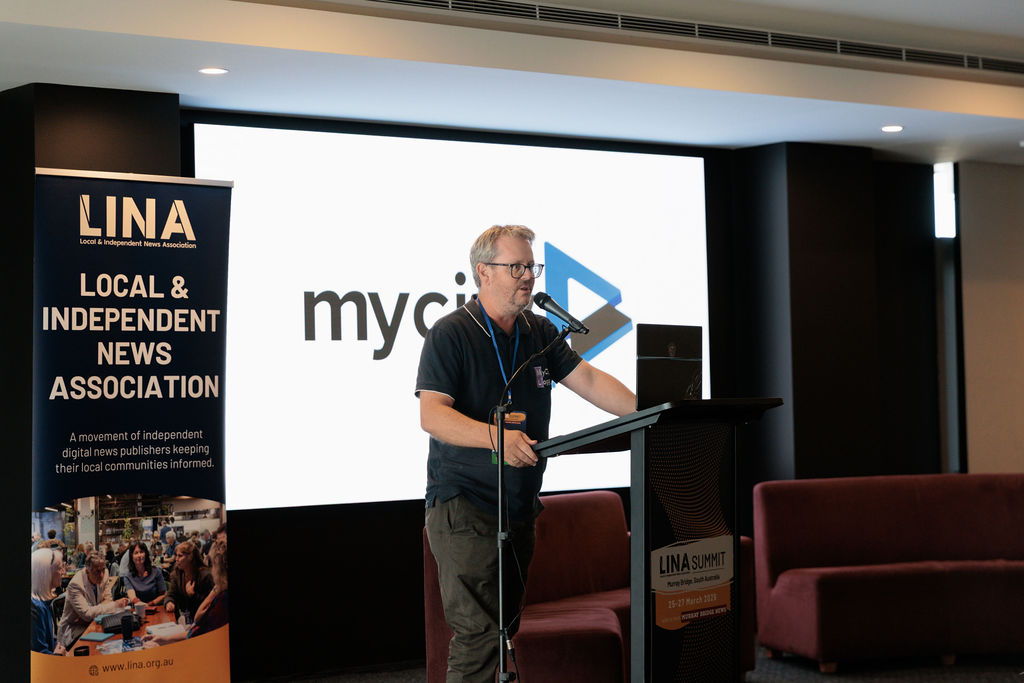
My City Media — Simon Holt
Simon Holt showcases some of the developments underway in Queensland.
- Simon (MyCity Media) is excited to announce Scoutly, a tool for publishers to try and find warm leads for advertising.
- Simon is really interested to trying new things- reach out to him to collaborate (LINA can put you in touch!).
DEBATE: Content creators are journalists in today’s media ecosystem
Adjudicator: In the Cove – Jacky Barker
Affirmative team:
- 8CCC FM – Kate Lyons-Dawson
- Lismore App – Simon Mumford
- Manly Observer – Kim Smee
Negative team:
- Riverine Grazier – Krista Schade
- Michael West Media – Kim Wingerei
- Manningham Life – Stella Yee
Publishers battle out the arguments for and against this controversial topic.
- While some content creators overlap with journalists in that they can hold power to account and help inform the public, they ultimately do not have the same codes and standards, accountability processes and training. Plus they can’t be LINA members!
With gratitude to our event supporters